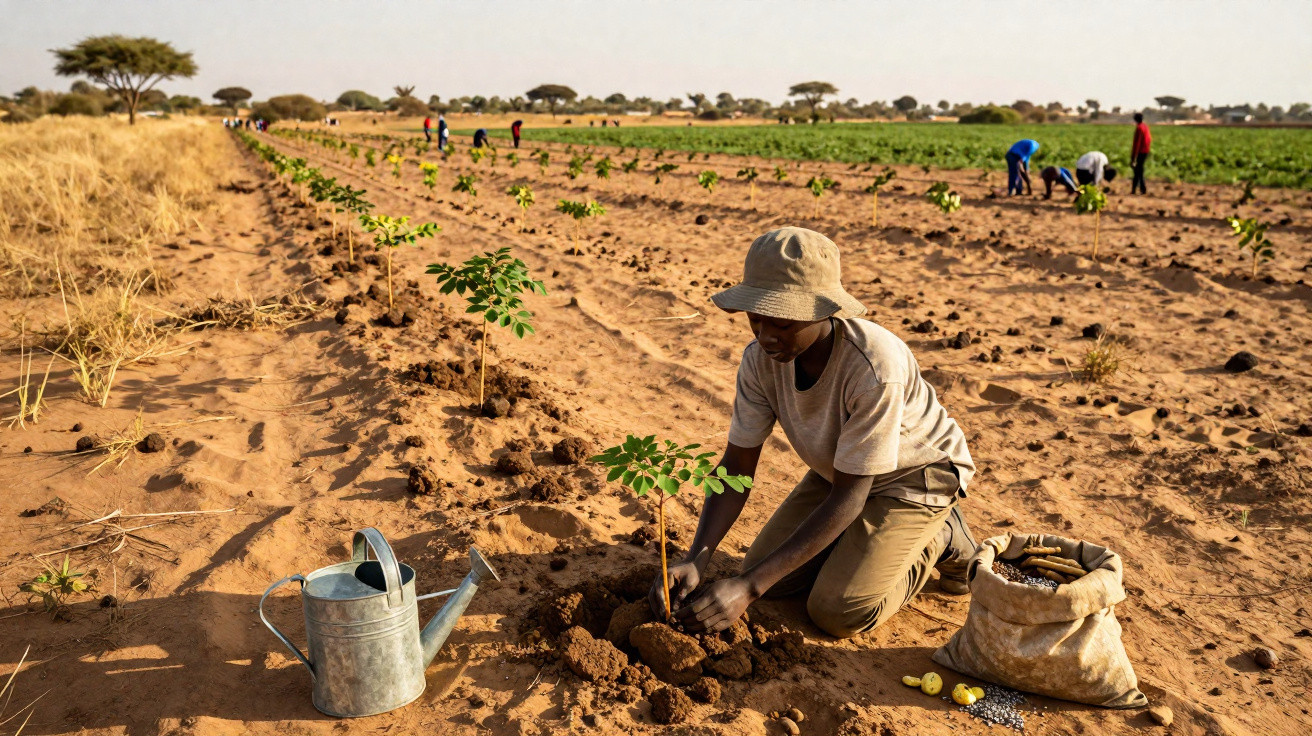
The Great Green Wall is an African initiative established to restore degraded land in the Sahel, the semi-arid belt south of the Sahara Desert. The plan began with 11 countries and a compelling vision: creating a green corridor of around 8,000 km from Senegal to Djibouti. Today, the project extends beyond tree planting, encompassing soil restoration, drought-resilient farming and income generation for rural communities.
What is the Great Green Wall?
The Great Green Wall is a programme led by African countries to tackle desertification, the loss of fertile soil and food insecurity. Its original ambition was to establish an uninterrupted belt of trees across the continent, but the approach has since developed into a mosaic of restored landscapes.
This mosaic brings together native trees, revived grasslands, community vegetable gardens, agroforestry systems and traditional water-management methods. Rather than attempting to “hold back” the Sahara as though it were a concrete barrier, the aim is to strengthen the Sahel so that its land can become productive again.
Which countries are involved in the 8,000 km wall?
The original core consists of 11 countries in the Sahel-Sahara region: Senegal, Mauritania, Mali, Burkina Faso, Niger, Nigeria, Chad, Sudan, Eritrea, Ethiopia and Djibouti. Each faces its own challenges, including drought, pressure on grazing land, erosion, rural poverty and forced migration.
In practical terms, the Great Green Wall relies on local action within every country:
- Planting species suited to dry conditions.
- Restoring abandoned farmland.
- Protecting young trees from livestock and premature cutting.
- Harvesting rainwater through small structures in the soil.
- Supporting farmers, herders and rural co-operatives.
Why is the Sahara advancing into the Sahel?
Land degradation in the Sahel is not driven by a single cause. The region experiences spells of drought, rising temperatures, intensive land use, deforestation, population growth and conflicts that make sustainable management of natural resources more difficult.
Once soil loses its vegetation cover, it becomes hotter, retains less water and is exposed to wind. When rain does fall, it runs off quickly rather than soaking into the ground. This cycle lowers fertility, weakens crops and forces rural families on to increasingly fragile land.
How is this green wall built in practice?
Its construction does not take the form of a flawless line of trees visible from space. In many places, the most effective approach is to protect native shoots already present in the soil, enabling old root systems to grow into trees and shrubs again without relying solely on new seedlings.
Methods differ according to the country, the soil and the available water:
- Assisted natural regeneration, protecting trees that emerge naturally.
- Planting acacias, balanites and other drought-resistant species.
- Using stone bunds to slow surface runoff.
- Creating small planting basins to concentrate water close to roots.
- Combining trees, crops and livestock rearing.
Why does this project matter beyond Africa?
The Great Green Wall matters because it connects climate, food, water and social stability in one of the world’s most vulnerable regions. As land becomes productive again, rural communities gain more food, shade, managed timber, grazing land and local income, easing pressure on places that are already degraded.
The challenge remains immense: inconsistent funding, insecurity in parts of the Sahel and weaknesses in monitoring slow progress. Even so, the green wall remains one of the world’s foremost symbols of environmental restoration, turning the fight against desertification into work carried out in the field, tree by tree and hectare by hectare.




Comments
No comments yet. Be the first to comment!
Leave a Comment