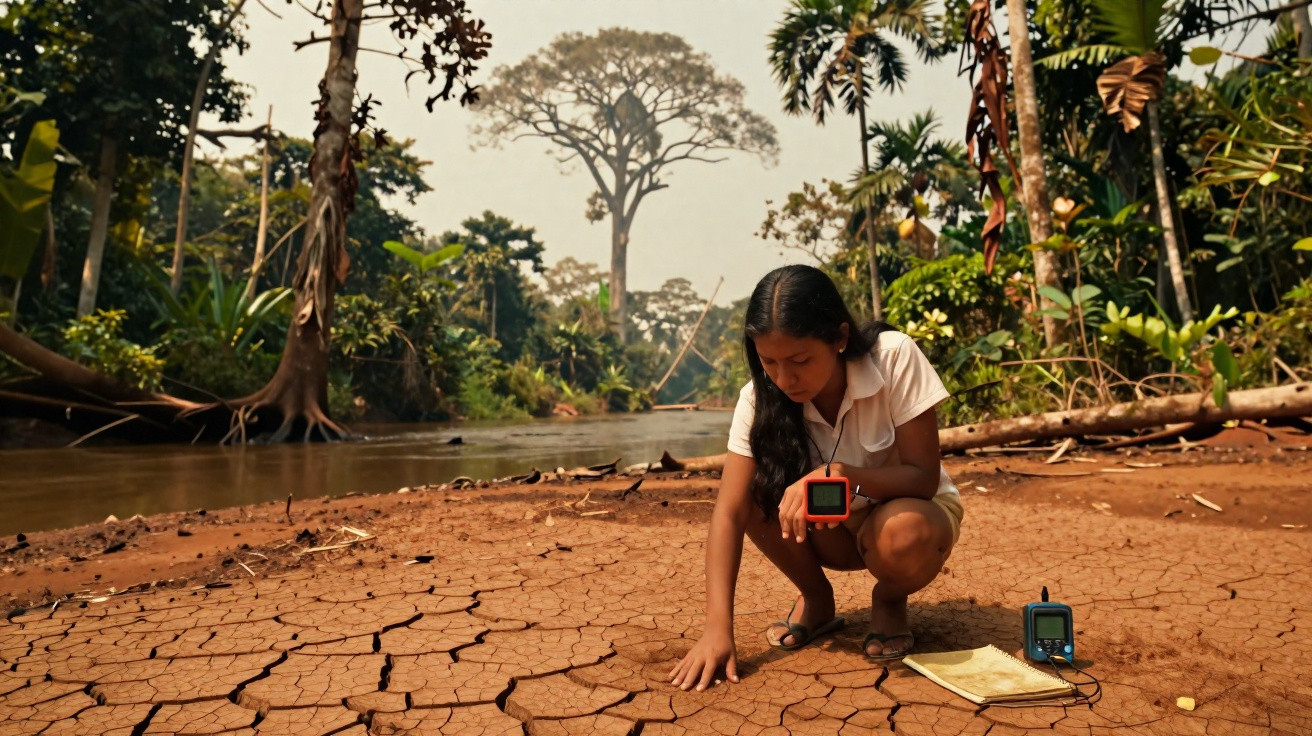
A new analysis of the Amazon rainforest indicates that the region is moving towards a ‘hypertropical’ condition, with droughts lasting longer, becoming hotter and occurring more often.
The international research team says these circumstances have "no current analogue". Trees are facing unprecedented levels of strain, while the Amazon’s ability to take in carbon dioxide is also declining.
Amazon rainforest moving towards a hypertropical climate
Drawing on information collected throughout the Amazon over more than 30 years, the researchers found the present and anticipated changes sufficiently severe to introduce a new term: ‘hypertropical’. The conditions being discussed have not existed anywhere on Earth for millions of years.
The team examined how trees and the soils supporting them react during spells of intense heat and drought. As such events worsen, they provide a short glimpse of what may become normal over the coming 100 years.
"When these hot droughts occur, that's the climate that we associate with a hypertropical forest, because it's beyond the boundary of what we consider to be tropical forest now," says geographer Jeff Chambers, from the University of California, Berkeley.
Using the data gathered by Chambers and his colleagues, models suggest these hot droughts will probably become more frequent by 2100 and persist throughout the year - including the wet season, which runs roughly from December to May.
Hot droughts raise tree mortality risks
Lower soil moisture is expected to cause trees to die at greater rates. It can lead to two connected issues: hydraulic failure, in which air bubbles obstruct water movement through trees, and carbon starvation, when leaf pores close to conserve water and photosynthesis is subsequently affected.
Measurements taken in the field indicate that this is already occurring during the most extreme conditions in today’s Amazon climate. Should the region become hypertropical, these extremes would arise far more regularly, potentially raising tree mortality by 55 percent.
"We showed that the fast-growing, low wood-density trees were more vulnerable, dying in greater numbers than high wood-density trees," says Chambers.
"That implies that secondary forests might be more vulnerable to drought-induced mortality, because secondary forests have a larger fraction of these types of trees."
Hypertropical forests could spread beyond the Amazon
One element of the research considered two particular Amazon locations hit by the droughts of 2015 and 2023, both associated with exceptionally warm El Niño events. The key water threshold matched at both sites in each year, pointing to a shift that could be widespread.
The researchers expect most hypertropical forests to develop across the Amazon, but anticipate they could also appear in Africa and Asia. As trees die, these forests may change from carbon sinks into sources of carbon.
Based on an extensive body of evidence, the projections offer another stark reminder of forests’ importance in maintaining atmospheric balance - and of the consequences should they disappear.
"It all depends on what we do," says Chambers. "It's up to us to what extent we're actually going to create this hypertropical climate."
"If we're just going to emit greenhouse gases as much as we want, without any control, then we're going to create this hypertropical climate sooner."
The research was published in Nature.








Comments
No comments yet. Be the first to comment!
Leave a Comment