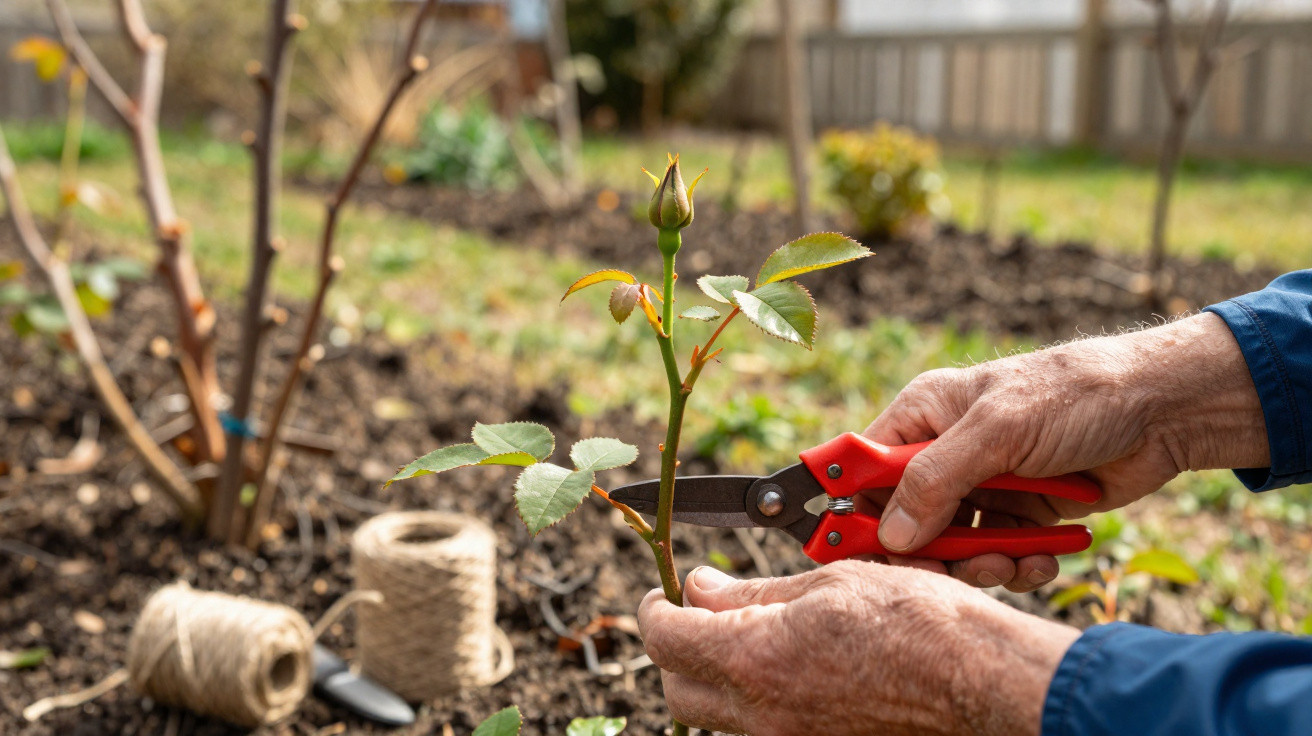
The rose bed may be looking forlorn, and the urge to act can be hard to resist.
For many gardeners, March seems the ideal time to give roses a thorough “tidy-up” with a severe cut-back. The border immediately appears orderly and manageable. However, repeating this instinct each year can gradually remove the very growth responsible for the finest summer flowers.
Why harsh March pruning quietly kills your roses’ best flowers
Visit a garden centre in late winter and you will often find lines of roses trimmed to identical heights, standing in ranks like soldiers. It appears tidy and efficient, even expert. It is easy to recreate that effect at home by cutting every cane to the same level and removing anything that disrupts the outline.
Roses are not privet hedges. A hedge copes with even clipping because it continuously replaces leaves all along its stems. Roses, meanwhile, hold energy in their canes and form future flowers on particular areas of wood, notably the growth produced in the previous year.
When you cut every stem low “just to be safe”, you often remove most of the wood that carries the future flower buds.
The brown or green canes made last season are not redundant growth: they are what powers flowering. Cutting them back severely in March removes them just as the rose begins to emerge from winter dormancy. Rather than developing buds, the plant has to devote weeks to rebuilding its framework, so flowering is reduced or arrives later.
This strain brings further problems. Less stored energy in the wood produces weaker new shoots. Big cuts made in unsuitable places may also provide ideal routes for fungal diseases, including powdery mildew and black spot, particularly when rain is followed by a late frost. The rose may remain alive, but the display of flowers you expected never materialises.
The overlooked detail: the “eye rule” that saves your rose display
The important point that nearly everybody overlooks is remarkably simple: inspect the buds, commonly known as “eyes”, carefully. These small raised points on a cane are the places from which new shoots will grow.
Before every cut, count how many buds you’re leaving, not how much wood you’re removing.
For a healthy bush rose, most specialists advise retaining roughly three to five eyes on every robust stem, measured up from the base. Adopting this straightforward practice makes a considerable difference:
- The rose retains sufficient wood in which to hold energy.
- Every bud left in place can produce a strong shoot carrying flowers.
- It prevents a congested mass of weak, slender growth that does not flower properly.
How you make the cut matters as well. Cut at a gentle angle a few millimetres above the final bud you intend to retain. This prevents water from collecting over the bud. Select a bud facing outwards, rather than one pointing into the middle of the plant. That minor decision shapes the rose as it grows: it encourages an open, well-ventilated plant instead of a tight clump vulnerable to disease.
First step before pruning: know what kind of rose you’re holding
March pruning does not affect every rose in the same manner. Treating all roses as though they were repeat-flowering bush varieties is among the most frequent errors.
| Type of rose | Main flowering | When to prune |
|---|---|---|
| Repeat-flowering bush rose | Several flushes from late spring to autumn | Late winter to early spring (around March) |
| Once-flowering shrub or old rose | Single bloom in early summer | Right after flowering, not in March |
| Repeat-flowering climber | Several waves on long canes | Late winter plus light summer clean-up |
| Once-flowering rambler | Abundant single flush | After flowering, removing a few old canes |
Repeat-flowering roses, often described as “remontant” in catalogues, flower repeatedly during the season. A properly structured pruning in late winter can suit them and may be beneficial, provided the buds are respected.
In contrast, once-flowering roses bloom on wood produced in the preceding year. Prune these hard in March and you are quite literally removing the entire display for that year. They are better pruned lightly as soon as flowering ends, with only a proportion of the oldest canes taken out to stimulate growth for the following season.
Climbing roses: same logic, different silhouette
Climbing roses can create further uncertainty. Gardeners often reduce them as though they were bush roses raised on stems, then question why flowers develop only at the top, if they appear at all.
With a repeat-flowering climber, focus on the permanent framework and its side shoots. Retain three to five vigorous main canes that are securely fixed to their support and remain green and supple. Together, these make up the long-term structure.
On climbers, the flowers come mainly from the short side shoots that grow off the main canes, not from the trunks themselves.
In late winter, shorten each of these side shoots to two or three buds, again choosing outward-facing buds where possible. This measured approach channels energy into a smaller number of powerful flowering stems rather than allowing weak growth to become tangled against a wall or trellis.
Three quick checks before any cut in March
1. Look for living wood, not just height
A cane that seems dry externally can still be alive. Lightly scrape the bark with a fingernail or the blunt side of a knife: green tissue underneath means it should be kept. Dead wood will instead show brown or grey material, and it will often break readily.
2. Spot the bud direction
Pause briefly to check the direction in which each bud points. A cut above an inward-facing bud sends the fresh shoot into the centre of the rose. This commonly reduces air circulation and increases disease risk. An outward-facing bud helps form an open, bowl-shaped rose that dries fast after rain.
3. Think of age, not just number of stems
Roses need a pattern of renewal. Each year, it is possible to remove one or two particularly old, woody canes right down at their base. This creates room and lets in light for younger, more productive stems. Avoid removing all the younger canes simply to produce an even height.
Common pruning fears and what really happens
Gardeners often cut roses back hard because they worry that the plants will “get away from them”. A tall rose with a slightly untamed look may seem untidy. Yet by midsummer, a rose pruned thoughtfully according to bud numbers will often look more attractive than one heavily clipped in March.
These are some familiar outcomes:
- The over-enthusiastic tidy-up: Every stem is cut to 15–20 cm. Result: plenty of fresh green growth, but few buds and flowering postponed until late in the season.
- The light, bud-aware pruning: Stems are reduced above three to five eyes, while only the oldest and weakest canes are removed. Result: a well-balanced plant, abundant early flowers and the potential for later flushes.
- No pruning at all: The rose flowers for two or three years, but then becomes crowded in the centre, suffers more disease and produces fewer blooms lower down.
Technical terms that actually help you prune better
Rose-pruning terminology can seem daunting, but several expressions genuinely make it clearer what you need to do.
“Eye” or bud: the small swelling on a cane that can develop into a new shoot. Counting eyes lets you decide where the next branch will grow.
“Framework cane” or structural cane: the thicker, principal stem that creates the shape of the plant. On climbers, these are the long trunks trained along a fence or wall.
“Lateral” or side shoot: a smaller branch emerging from a framework cane. These are usually cut back to two or three buds in March.
Knowing these terms makes pruning less of a guessing game and turns it into a set of practical decisions: retain this framework cane, shorten that lateral and count those buds.
Additional spring care that boosts flowering after pruning
Pruning is only one part of achieving a good floral display. A handful of easy jobs immediately after your March pruning session will help roses recover and thrive.
- Collect and dispose of all fallen leaves and prunings around the base to reduce the carry-over of disease.
- Once growth begins, use a slow-release, balanced rose fertiliser at the rate stated on the packet.
- Spread mulch, such as well-rotted manure or composted bark, but leave a small gap around the stems.
- Inspect stakes, ties and trellis attachments on climbing roses to ensure that they can safely carry the new, heavier growth.
Combining bud-count pruning with this light aftercare produces a vigorous, resilient rose. Flowers then arrive not by chance, but as the expected outcome of a few carefully timed actions.
Gardeners who like to experiment may find it useful to keep a small notebook for one season. Record the number of buds left on several representative stems, then note how many flowers form on those same canes. By the following winter, your own observations will direct your hand more effectively than general advice, and that easily missed detail of the buds will become instinctive whenever you reach for the pruners in March.









Comments
No comments yet. Be the first to comment!
Leave a Comment