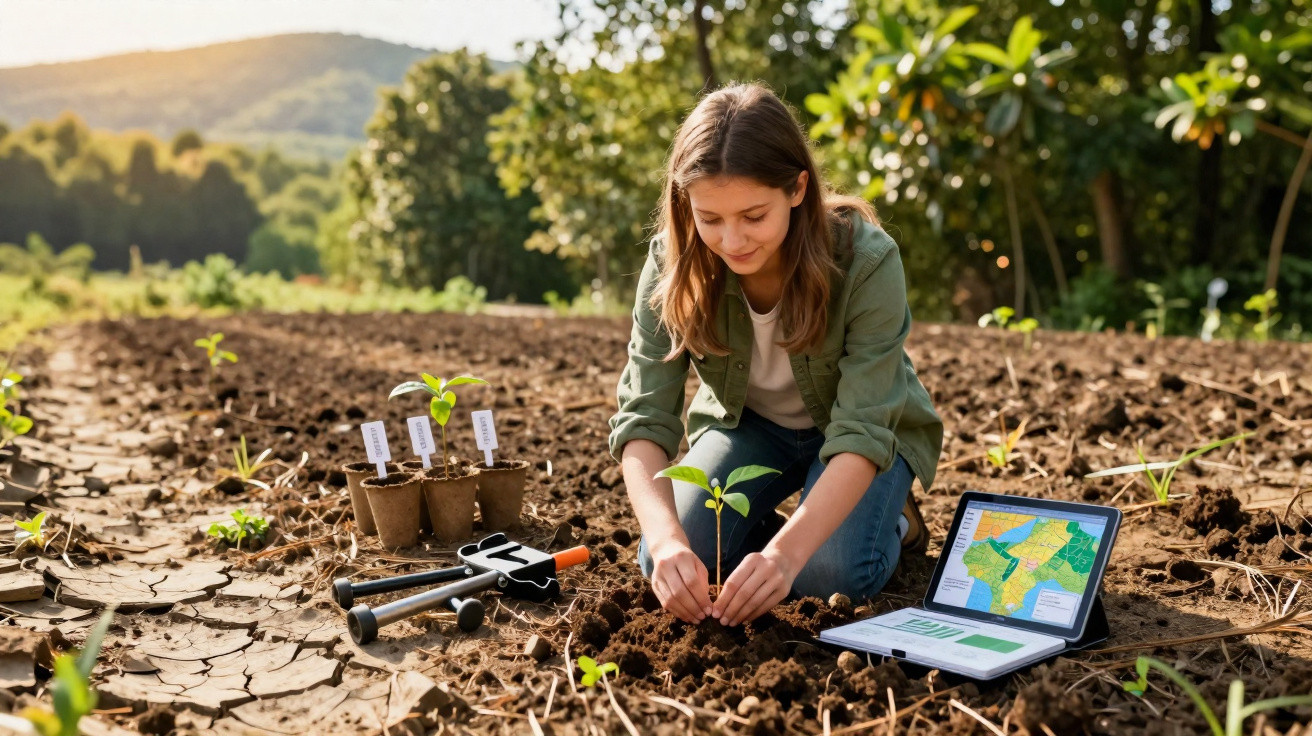
Where wind once scoured bare, fissured earth, a soft, unbroken rustle now rises from leaves brushing together. The air is denser and cooler, as though somebody has dimmed an unforgiving landscape. Women and men follow a dusty path between young trees: some are no wider than a wrist, while others already throw broad shade. A boy wearing a faded football top reaches out to touch a leaf, as if making sure it truly exists.
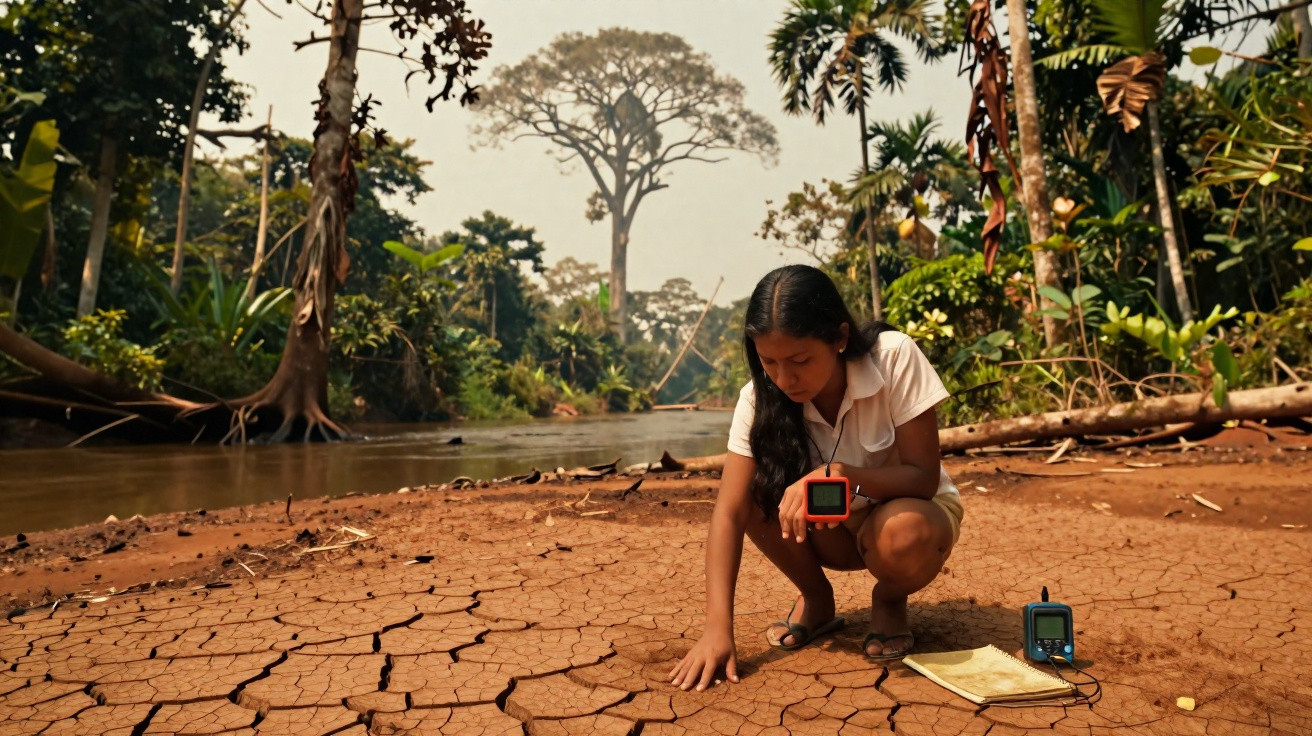
Twenty-five years ago, this whole valley was a scorched, eroded wound. Nothing rose above knee height. Livestock stirred up clouds of grey dust. As the land could no longer sustain them, people left. Now, the same slopes form an unexpected mosaic of green: small woodlands joined together through human determination and patient labour.
Beyond view, satellites are tracking how the air above these trees has altered. The figures are striking, but the story behind them is more unusual still.
From dust to carbon sinks: what 25 years of trees can really do
Walk through one of these renewed landscapes at noon and your body registers the science before you see a chart. Beneath the canopy, the temperature falls by a few degrees. The scent changes from hot metal and fumes to wet earth and resin. Ground that was once as hard as concrete yields slightly with each step.
Land formerly labelled “degraded land” in official reports has become something entirely different: a living system steadily drawing carbon from the atmosphere. It does not happen dramatically or overnight. It is more like slow, persistent breathing. Every trunk forms a store of carbon, while every root reaches through the soil and secures more of it below ground.
Thousands of these “before and after” landscapes can now be found across continents. Individually, each may appear modest. Taken together, they account for millions of tonnes of CO₂ removed from the atmosphere each year.
Consider China’s Loess Plateau, frequently referenced in scientific literature yet remarkably unremarkable when seen on the ground. During the 1990s, it was among the world’s most heavily eroded areas: yellow dust storms, deep gullies gouged into exposed hillsides, and villages barely holding on at the margins. The government began a vast programme of reforestation and terracing. Communities planted trees, constructed barriers, and altered the way and places in which they cultivated the land.
Move forward about 25 years and satellite imagery reveals that plant cover has doubled in certain places. Forests and grasslands have reappeared. Research suggests that the plateau’s restored ecosystems now capture millions of tonnes of carbon annually. This is not a single event, but an ongoing process as tree trunks grow wider and soils recover organic matter.
Comparable changes are taking place in parts of Ethiopia’s Tigray region, India’s Andhra Pradesh, and the fragments of Brazil’s Atlantic Forest that are being reconnected. None of these schemes is flawless. Some use unsuitable species combinations. Some trees fail. Other areas are affected by drought or political disruption. But viewed at a larger scale, the direction is clear: reforested land is functioning as a CO₂ sponge, storing carbon in biomass and soil that previously had nowhere to go.
The principle behind this green sponge is reasonably simple, even where implementation is complicated. Through photosynthesis, trees take in CO₂ and convert it first into sugars, then into wood, bark, roots and foliage. A mature woodland contains vast quantities of carbon in its living material. Yet soil is the less visible champion. Fallen leaves and dying roots add organic material beneath the surface. Microbes, fungi and insects process it, and some of that carbon becomes attached to soil particles for decades or even centuries.
For a barren landscape beginning this recovery, the process resembles filling an empty warehouse. Storage rises rapidly at first, as pioneer species arrive and occupy the available space. After a couple of decades, the rate slows, although the overall quantity of carbon retained continues to increase. Researchers describe these regenerating places as “carbon sinks” because they absorb more carbon than they emit.
The important qualification is that reforestation is not all the same. Thick monoculture plantations can accumulate carbon rapidly, but are vulnerable to pests, fire and market fluctuations. More varied forests containing multiple species develop less evenly, yet their carbon stores are generally more secure over the long term. This is the direction many enduring projects are taking: moving beyond simply planting trees towards restoring ecosystems able to keep absorbing CO₂ year after year.
How the world actually pulled this off (and what it got right and wrong)
In theory, “plant more trees” seems absurdly straightforward. In practice, successful reforestation depends on unglamorous, practical habits: hearing local communities, selecting species familiar to local people, and planning over 20 years rather than three.
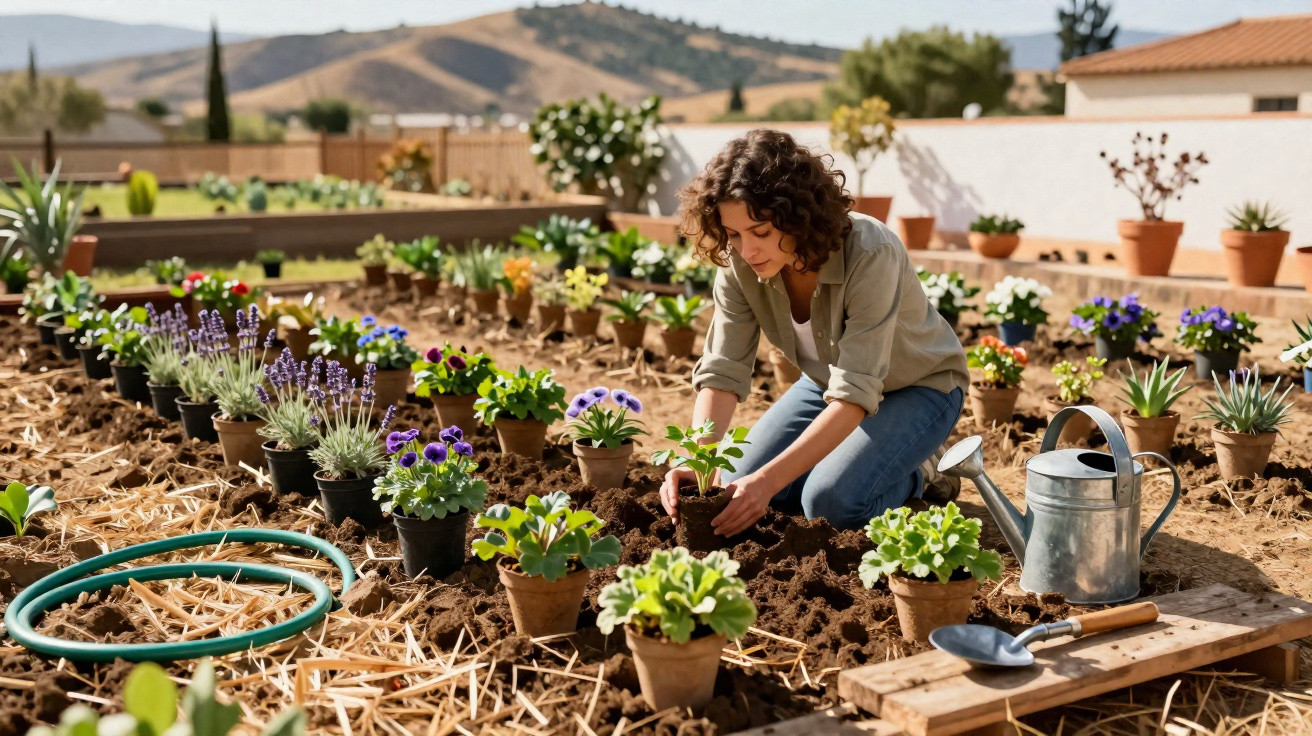
One essential approach is to begin locally and on a small scale. Instead of scattering millions of identical seedlings from aircraft, many groups established community nurseries. Residents gathered seeds from surviving native trees, raised them in old oil tins or plastic tubes, and planted them shortly before the rains arrived. They shielded young trees with basic fences, stones, and sometimes thorny branches to prevent goats reaching them. It may not be glamorous, but it is how trees survive the dry season.
A further vital element is combining quickly growing “nurse” species with slower-growing, long-lived trees. The fast-growing varieties rise within a few years, providing shade, cooling the soil and reducing wind exposure. More sensitive species can establish themselves under this cover. In time, the short-lived pioneers either recede naturally or are thinned out, creating a more layered and robust forest that continues to draw carbon from the air without continual human support.
At a human level, early waves of reforestation delivered a hard lesson: it is not enough to arrive, plant trees and depart. Many initiatives in the 1980s and 1990s failed because they overlooked the people living on that land. Trees were cut down for fuel. Livestock had nowhere left to graze. Local farmers were understandably unenthusiastic about having somebody else’s climate objectives imposed on their fields.
More recent successes have reversed that model. Rather than excluding communities behind fences, they placed them at the centre: paying people to plant and care for trees, connecting new forests to work in honey production, ecotourism or sustainable timber, and granting legal rights to manage restored land. Let us be honest: nobody spends years watering saplings purely out of affection for CO₂ graphs.
When households experience direct gains-such as fuller wells, additional income or shade for crops-they become the trees’ natural protectors. At that point, reforestation becomes less of a one-off scheme and more of a continuing practice that endures after overseas funding has disappeared. Better carbon figures are almost a by-product of this more profound social change.
“Trees are the slowest kind of news,” a Kenyan restoration leader told me. “You plant a headline today and read the story in twenty years.”
Climate headlines often miss how personal this work can be. On a hot afternoon, someone may point out the bare rock where their grandparents once grazed animals, now a shaded strip where their children play, and you can feel a subdued blend of pride and relief. In difficult years, when drought arrives or fire destroys a hillside, there is grief and anger as well. We have all known the moment when we realise that the things that matter most take far longer to build than we had hoped.
- Select native or well-adapted species that local communities value.
- Safeguard young trees during their first 3–5 years, when they are at greatest risk.
- Where possible, integrate trees with crops or grazing rather than excluding people.
- Prepare for fire, pests and political change, not merely the planting day.
- Assess soil health and benefits to communities, not only the number of trees.
What these new forests mean for your future (and your choices)
What, then, does this mean? Following a quarter-century of careful reforestation across dispersed regions, the global carbon equation has shifted slightly. Landscapes once stripped bare-which reflected heat and released CO₂ from depleted soils-are now absorbing millions of tonnes of carbon each year. This does not erase the fossil-fuel era, nowhere near. But it does alter the curve’s gradient a little.
Scientists estimate that natural climate solutions, including reforestation, improved soil management, and the restoration of mangroves and peatlands, could provide up to a third of the climate mitigation required by 2030 if properly scaled. That is a substantial figure, and it matters. However, it only remains true if forests are left standing. Fire, logging and short-term profit can reverse decades of quiet carbon storage in one season.
It is tempting to treat these green hillsides as a moral offset: permission to carry on driving, flying and consuming as normal because somebody, somewhere, has planted a tree. That story is dangerously comforting. A more truthful account is harder, and more compelling: reforested landscapes demonstrate what can happen when people choose repair over extraction. They offer time and resilience. They do not provide a free pass.
Even so, millions of young trees contain another possible story about the future. It is one in which climate action means more than high-tech carbon-capture facilities and faraway pledges: it means hands in soil, seedlings in bottles, local meetings beneath tarpaulins, and difficult decisions about land use. It is one in which a place that once forced people away can gradually become somewhere that keeps them.
This is the part worth remembering and discussing. Not because it is tidy or heroic, but because it is complicated, tangible and already under way. Somewhere today, someone is placing a slender green stem into a hole in the earth, on land their grandparents called dead. Twenty-five years from now, that small, nearly unseen act may be one reason the air you breathe feels a little easier.
| Key point | Detail | Why it matters to the reader |
|---|---|---|
| Reforested lands as carbon sinks | Areas that were once barren now absorb millions of tonnes of CO₂ each year | Provides a tangible picture of how long-term restoration can alter the atmosphere |
| Human-centred restoration | Projects work when local communities lead them and benefit directly | Demonstrates why social justice and climate action are closely connected |
| Limits and potential | Reforestation makes a major contribution, but cannot replace deep emissions cuts | Avoids false reassurance while emphasising genuine hope and agency |



Comments
No comments yet. Be the first to comment!
Leave a Comment