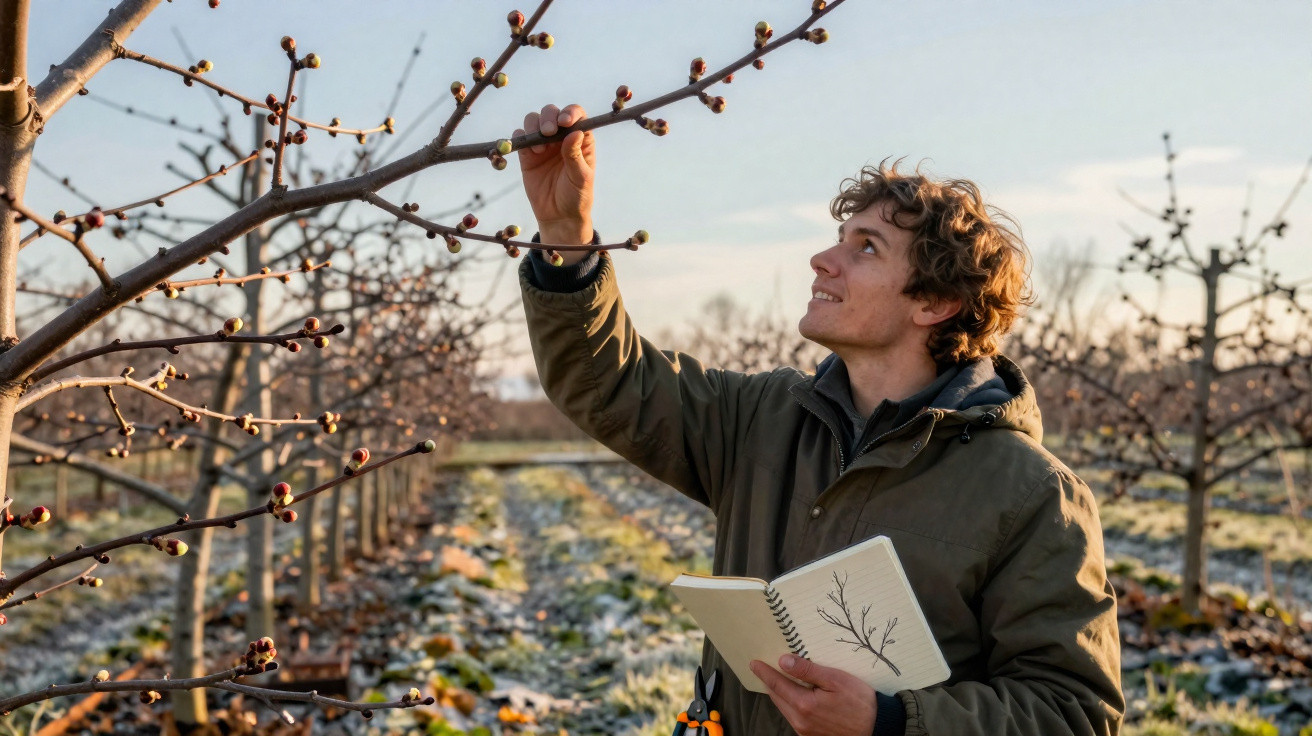
No leaves, no blossom, nothing worthy of Instagram. Only naked branches set against a dull January sky. At first, the tree seemed dormant, even slightly forlorn. Then someone paused, moved closer and smiled with the quiet recognition known only to people who understand trees.
Those branches already carried a message. Minute forms, subtle colour variations, the way every shoot reached towards the light or curved downwards. In midwinter, the coming harvest was already leaving its signature in code. Once you learn how to spot it, you will see it everywhere.
January hardly feels like harvest time. Even so, the branches are already revealing the facts.
What January branches really reveal about your future apples
When you stand before an apple tree in January, it is easy to assume that nothing is going on. There are no humming insects, fruity scents or crisp ripe apples. There is only bark and buds. Yet these leafless branches offer a frank visual prediction for the season ahead.
Shoot thickness, the amount and form of the buds, and the angle of every branch all form part of a quiet exchange between the tree and the previous year’s weather. Robust, well-exposed branches capped with full buds suggest a “good harvest”. Thin, tangled, shaded growth bearing small pointed buds indicates that the tree had a difficult year.
An apple tree conceals nothing during winter. Its branches display the previous season clearly and, if you interpret them properly, you can begin to predict how many baskets you may fill in autumn.
Any seasoned orchard keeper will talk about “reading wood”. A retired fruit grower in Kent still walks through his rows during every New Year week. He pays little attention to the trunk. Instead, he watches the branch tips, the sides of the previous year’s shoots and the pattern made by buds along the wood.
He recognises that the large, rounded buds found on short, stubby spurs are where apples will form. In January, he can stand beneath a tree, look upwards and announce: “This one’s loaded,” or, “This one’s resting.” He is seldom mistaken. Decades of experience have taught him that winters with plenty of vigorous one-year shoots often come after a light crop, while trees that bore excessively the year before are left with thinner, depleted wood.
Garden centres do not often mention this. They market blossom and flavour. But winter wood provides the more useful account: crop quantity, consistency and even likely fruit size, before a single flower has opened.
The principle becomes straightforward when you take time to observe. Apple trees must balance two major tasks: producing wood and producing fruit. In a year with good light, sensible pruning and a moderate crop, a tree can do both. You should find healthy extension growth at the tips, alongside many short productive spurs carrying rounded flower buds.
When a tree has carried too many apples, much of its energy has gone into ripening them. Its branches often expose the result. Growth rings become shorter, shoots are finer, and buds are smaller and more pointed. Usually, those sharp buds are leaf buds rather than flower buds. Unless you take action, that means fewer apples this year. Conversely, strong fresh shoots combined with plenty of mixed or flower buds show that the tree had enough “budget” to support both its future framework and its crop.
The branches are essentially your tree’s bank statement. Plenty of healthy fresh wood and swollen buds? The account is in credit. Limited growth and minute buds? The tree is still paying for last year’s excessive crop.
How to read apple buds and branches like an orchard professional in January
Begin with buds at eye level. Gently hold one between your finger and thumb. Is it rounded, almost enlarged, and positioned on a short spur? It is highly likely to be a flower bud. Is it slim and spear-like, pressed against a long, narrow shoot? That is generally a leaf bud, intended for growth rather than fruit.
Circle the tree at an unhurried pace. Notice where the majority of the fuller buds are concentrated. For many varieties, they grow on small knobbly side spurs, resembling tiny knuckles along older branches. A branch scattered with these “knuckles” and rounded buds is effectively a promise of apples. One that consists only of a long bare stem with occasional pointed buds is declaring: “I’m still building, not fruiting.”
Then assess the angles of the branches. Upright, vertical shoots usually put their energy into leaves and extension growth. Branches held more horizontally, or at a gentle slant, tend to carry the greatest number of fruiting spurs. If your January tree has many vertical whips but few relaxed, spreading branches, it is telling you that it remains in its adolescent phase. Your role is to guide it towards maturity.
Once you understand the message in its buds and branches, pruning becomes entirely different. Rather than cutting at random, you are editing a narrative. Retain more branches with rounded buds running along their length, as these are your fruit-producing branches. Shorten or remove some lengthy upright shoots carrying only pointed buds, especially where they congest the centre of the tree.
This is why January is so useful. With the leaves gone, the tree’s structure is visible and you can make informed decisions. Would you prefer larger apples instead of hundreds of undersized ones? Thin some heavily budded spurs, or shorten selected branches so the tree is not attempting to support too much fruit. Does the tree appear worn out, with weak and slender wood? Reduce the fruiting wood slightly, allowing it to recover and create stronger branches.
Commercial orchard workers move along winter rows with secateurs and an internal calculator. Each cut reflects a judgement about the fruit load a tree can bear without becoming depleted again. You can use the same approach in your own garden, even with just one tree beside the shed.
There is an emotional element to reading a tree in winter too. On a grey January afternoon, with cold hands and visible breath, a tree can look rather pitiful. Weak, congested growth might leave you feeling that you have “failed” it. In a favourable year, substantial branches may make you quietly proud. In a difficult year, take what you see as information rather than a verdict.
Many home growers carry ongoing guilt about what they “should” have done: thinned more fruit, watered more regularly or offered better protection. The branches are not blaming you; they are showing you where support is needed next. A mass of upright whips may mean your previous pruning was too severe. Almost no new wood could indicate that the crop load or drought was too demanding.
Let’s be honest: nobody truly does this every day. Most of us take a quick look, shrug and return indoors for a cup of tea. Yet spending ten minutes in January properly examining the wood is one of the easiest ways to improve future harvests without purchasing a single product.
“Winter is when the tree speaks clearly. Leaves are noise. Wood is truth.” - veteran orchardist, Herefordshire
Once that thought takes hold, January is no longer an empty month. It becomes the month for diagnosis. You may even start to enjoy those slow walks around the trunk. You begin connecting what you observe in winter with what you recall from summer: the overloaded branch that broke, or the side of the tree whose fruit never coloured well. The branches in front of you now are the outcome.
- Seek out plump, rounded buds on short spurs: these are likely to be flower buds and future fruit buds.
- Pay attention to long, narrow shoots with pointed buds: these are largely leaf growth and can be overly vigorous when crowded.
- Prioritise gently sloping or horizontal branches for fruit, and be more rigorous with congested vertical shoots.
- Let what you observe guide pruning, feeding and thinning, rather than using it to blame yourself or the tree.
Let your January apple tree reshape your gardening throughout the year
Once you understand that an apple tree is announcing its crop as early as January, it becomes difficult to think of winter as a complete pause. The same branches contain last year’s record and this year’s first draft. Every bud represents a small choice the tree has already made, long before you taste any fruit.
During some winters, you will realise that the tree is taking a rest. There may be fewer flower buds, more slender leaf buds and less spectacle. That can be an excellent year to concentrate on form and wellbeing: make better pruning cuts, add a little compost around the base, or finally support that leaning post. In other winters, branches will be crowded with full buds and short spurs, and you may quietly pledge to thin the fruit properly this time, rather than merely watching branches bow under its weight and hoping for the best.
On a human level, interpreting branches in January can be unexpectedly grounding. You stop waiting for miracles to appear without cause. You see how the decisions you made last summer - or did not make - remain visible. You also recognise how forgiving a tree can be. Even a neglected apple tree will make another effort if you provide light, air and some considered pruning. On a cold morning beneath its bare canopy, you can almost sense next autumn’s fruit already resting in your hand.
| Key point | Detail | Why it matters to the reader |
|---|---|---|
| Read bud shape | Rounded buds on short spurs = likely flowers; pointed buds = leaves | Predict fruit quantity several months in advance |
| Observe shoot vigour | Fine, numerous shoots after a heavy crop; sturdy shoots after a lighter year | Adapt pruning and care to prevent the tree becoming exhausted |
| Consider branch angle | Horizontal branches carry more fruit than vertical shoots | Arrange the framework for consistent crops that are easy to pick |




Comments
No comments yet. Be the first to comment!
Leave a Comment