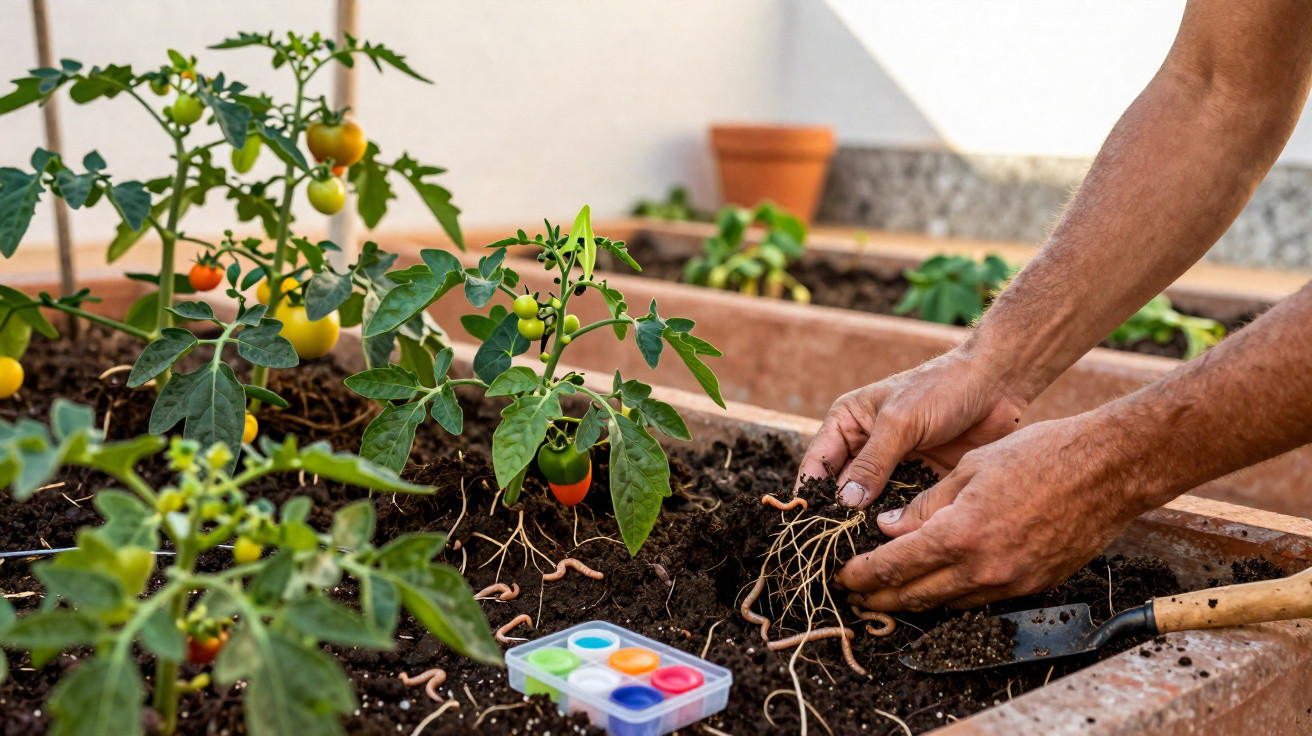
The garden could have come straight from a magazine. Thick clusters of shiny leaves, flower beds bursting with blooms, and greenery in every available space. Neighbours paused by the fence, praised its jungle-like appearance and asked for cuttings. It looked flawless in photographs. Inside the kitchen, however, the reality was different: just a handful of cherry tomatoes all summer, one small bowl of strawberries, and herbs that bolted before you had the chance to taste them.
You stand there holding your colander, looking across a mass of plants with barely any food to show for it.
Something is clearly wrong.
The hidden battle beneath your lush garden
Most gardens that are beautiful but unproductive have the same unseen issue: plenty of leafy growth, but too little life in the soil. Above ground, everything appears plentiful. There are leaves, stems, flowers and vines scrambling over one another as if competing. It is the sort of growth that makes you feel successful.
Below the surface, though, the situation is very different. Roots compete quietly for oxygen, moisture and nutrients. The soil may be compacted, exhausted or, at times, waterlogged. There is no shortage of plant growth, yet the system that supports fruit and vegetables is barely functioning. Instagram does not show you that. Your plate does.
Last summer, Maya proudly shared a photograph of her “urban jungle” with a gardening group. Her raised beds formed a solid wall of green: huge courgette leaves, dense tomato foliage and nasturtiums spreading across everything. It resembled a permaculture fantasy.
When she asked why she had harvested only two courgettes and one misshapen pepper, the group went quiet briefly. Then the questions appeared: “What’s your soil like?” “How deep are your beds?” “How often do you water?” She eventually explained that her beds contained mostly builders’ rubble, covered with 10 cm of inexpensive compost, and that she watered lightly every evening.
This lush yet unproductive result commonly comes from a mismatch between vegetative and reproductive growth. Put simply, plants are directing their energy into leaves rather than flowers and fruit.
It often occurs where nitrogen levels are high but the soil lacks structure and minerals. Roots remain close to the surface: comfortable, well supplied and reluctant to travel downwards. The plant feels secure and postpones reproduction. Severe stress will kill a plant, but gentle, carefully managed stress can prompt it to set fruit. A garden that gives plants nothing but comfort produces visual beauty rather than calories.
The quiet solution: care for the soil, not only the plants
The most effective step is not another fertiliser, but restoring the world below ground. Begin with a spade test. Push a spade into the area where your plants are growing and pay attention to what you feel. Does it hit resistance after only a few centimetres? Are roots turning sideways rather than growing down? That is the quiet underlying problem: compacted, inactive soil that appears acceptable from the surface.
Use a garden fork to loosen it gently, creating passages rather than turning the soil over. Apply plenty of organic material, such as compost, well-rotted manure or leaf mould. Next, protect the surface with a light mulch. Your aim is soil that behaves like a sponge, not a hard crust. When soil can breathe, roots can reach further down. When roots grow deeper, plants begin moving from “leaf mode” into “produce mode.”
The main danger is pursuing fast, visible results. You place plants too close together “because it looks bare otherwise.” You add generous amounts of high-nitrogen feed because the sudden flush of green seems successful. You water sparingly but frequently so that the surface never appears dry. Each of these habits reinforces the same problem: shallow roots, soft foliage and a poor harvest.
We have all had that moment when sharing a beautiful green photograph feels more appealing than giving the soil another month to settle. Honestly, hardly anyone checks their soil-test results every month. Yet the gardens that feed households quietly for years are usually those where somebody gave up one extra season to concentrate on the soil rather than the decoration.
A useful way to think about it is in layers: soil life first, then roots, then leaves, followed by flowers and fruit. Reverse that sequence and disappointment follows.
“Soil isn’t a background,” says a veteran market gardener I met on a rainy morning. “Soil is the main character. The plants are just the way the soil speaks to you.”
To restore that balance, many experienced growers use a short checklist:
- Loosen the soil once each season with a fork rather than a tiller.
- Spread 2–5 cm of mature compost over the surface instead of mixing it in.
- Protect bare soil with mulch or a living cover crop.
- Give plants enough room that their leaves only just meet at full size.
- Apply strong feeds infrequently and gentler feeds regularly.
When a lush garden begins to feed you
There is often a quiet turning point in the second or third year of looking after the soil. Leaves may become slightly less enormous, and the beds may no longer seem so crammed. The jungle effect settles. Then you begin to see a different change: nearly every tomato flower appears able to set fruit, beans hang in clusters, and courgettes seem to arrive almost overnight.
The same square metre that once produced a single photogenic sunflower can now fill a basket. The garden ceases to be a backdrop and begins acting like a pantry. That is when you realise that lushness has finally been matched by productivity.
The change is not dramatic or noisy. It feels more like the garden is breathing out. Even in dry weather, the soil remains slightly springy. Watering becomes occasional rather than frantic. Plants are less likely to topple in the wind because their roots extend deeply. The garden is still lush, but it is fuller, calmer and less attention-seeking.
You also start to spot small signs: more worms, tiny mushrooms after rainfall and fewer leaves turning yellow. The garden looks less like a display and more like an ecosystem. Beauty and yield no longer compete with one another.
What surprises many people is how modest the “fix” can be. It means observing more and reacting less, allowing more space and avoiding overcrowding, using slightly less nitrogen and practising a little more patience. You may still lose a plant, make a mistake in a bed or forget to mulch one corner. That is normal. A garden that produces food seriously will never be perfect.
When the harvest feels disappointing, return to the spade, the scent and the feel of soil in your hands. That is where the imbalance began, and it is where it can be resolved. A productive garden is simply a beautiful garden whose priorities have been quietly rearranged.
| Key point | Detail | Value for the reader |
|---|---|---|
| Soil imbalance is the hidden cause | Compacted soil with little life directs plants towards leaf growth instead of fruiting | Helps explain why a lush garden can still give poor harvests |
| Gentle soil work beats heavy feeding | Light loosening, compost and mulch develop deeper, stronger root systems | Gives a realistic method to increase yields without expensive products |
| Spacing and stress shape productivity | Suitable spacing and mild, controlled “stress” encourage plants to fruit | Shows how small changes in layout and care boost real food output |






Comments
No comments yet. Be the first to comment!
Leave a Comment