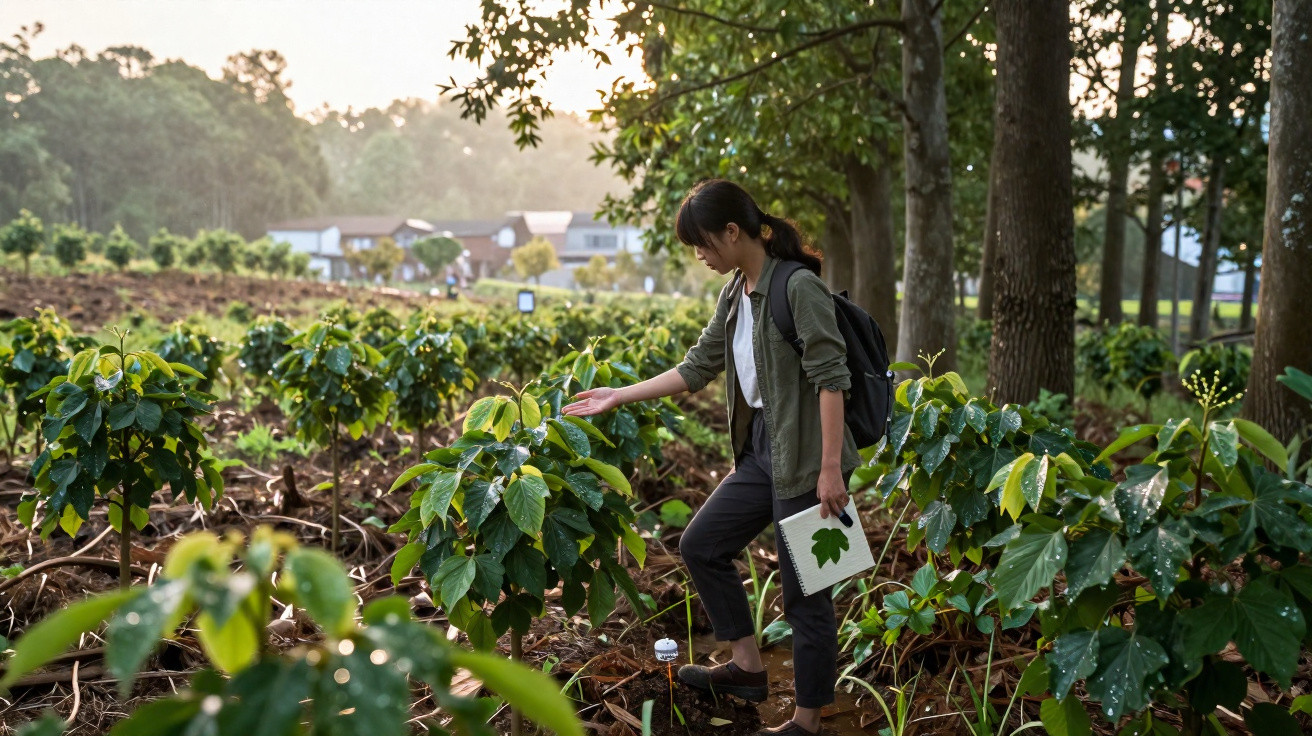
Not the trees, the birdsong or even the sudden shade. It is simply the air. Cooler, denser and almost moist against your skin, as though somebody had discreetly lowered the thermostat while raising the humidity. A decade ago, this hillside contained more dust than earth, and heat would shimmer above the ground before late morning. Today, a young forest runs to the horizon, its leaves rustling in a breeze that once did not exist. An elderly farmer gestures at the sky and laughs: “We used to watch the clouds pass us by. Now they stop.”
He is right. Local weather stations have recorded the change, as have satellites. Once the trees returned, the climate here began to alter… slowly at first.
When forests return, the weather changes too
Step from an exposed field into a reforested valley on a hot afternoon and your own body becomes a thermometer. The glare softens and the harsh brightness falls away. Air that felt dry and biting only a few paces before now seems to settle around you. Through transpiration, leaves release unseen vapour that helps feed small clouds far overhead. Birds glide on the cooler air currents. There is a slight yet tangible boundary: on one side is ground radiating heat; on the other is a living sponge absorbing it.
Researchers have been trying to measure that sensation. They use thermometers near the ground, weather balloons and satellite imagery that records surface temperatures and cloud cover. Gradually, the evidence is supporting what people working the land have long observed: when trees return over a substantial area, they reshape the local climate. It does not become a rainforest overnight, but the change is noticeable.
On China’s Loess Plateau, where large-scale reforestation started during the 1990s, scientists documented a quiet transformation. As millions of trees became established on eroded slopes, average land-surface temperatures in restored areas dropped by up to 1–2°C on summer days. Rainfall, made unreliable by decades of degradation, became a little steadier and somewhat more plentiful. Farmers began to report fewer “dead seasons”, when crops would simply scorch and fail.
In some areas of Brazil, cleared cattle pasture was replanted with native woodland and mixed-use forests. Weather stations detected lower daytime highs alongside modest but persistent rises in local rainfall. It was not a dramatic deluge of change, but more like turning a tap from a “trickle” to a “steady stream”. A Brazilian climatologist called it “turning down the volume on the heat, and adding a few more beats of rain”. Satellite maps showed the renewed green areas emerging as cool islands within an increasingly warmer landscape.
The physics behind these trends is straightforward. Bare earth and tarmac warm rapidly, then send that heat directly back into the atmosphere. Forests work another way. Their leaves operate like countless miniature air conditioners, transferring water from the soil into the sky. Evapotranspiration requires energy, so much of the sun’s energy goes into turning liquid water into vapour rather than warming the air.
Dark green tree canopies absorb more sunlight than pale, barren ground, yet they release much more moisture as well. That moisture contributes to low cloud formation, and those clouds reflect some sunlight back into space. It is a delicate contest between water and energy. Across sufficiently large landscapes, that contest becomes local climate: cooler afternoons, slightly damper air and a greater likelihood that passing clouds release rain here rather than twenty kilometres away.
How reforestation cools and moistens a landscape
For a local climate that is cooler and less fragile, where brief heatwaves do not immediately destroy the growing season, the first “method” is not a piece of technology. It is a map. The strongest reforestation schemes start by identifying places where new trees can genuinely alter the movement of air and water, rather than merely improve the view. These may be ridges that channel hot winds, valleys where dawn fog already lingers, or strips beside rivers where the soil still retains water.
Planting thick, varied lines of trees along these “climate levers” forms corridors of shade and moisture. Within several years, these wooded paths begin to redirect airflow, slowing hot gusts and fostering cooler breezes. On the Loess Plateau, farmers discovered that planting in arcs and bands following the terrain worked better than laying out straight lines across a flat map. The forest is not wallpaper; it’s a set of lungs carefully placed so they can breathe properly.
There is an inconvenient reality: most people love the thought of trees, but not the lengthy, untidy task of raising them. Let us be honest: nobody really does that every day. Many reforestation efforts fail because trees are treated as furniture - something fitted once and then ignored. Saplings require several years of attention before they can begin to influence the local climate in any meaningful way.
The same errors occur on continent after continent. Vast blocks of a single species are planted because they are simple to manage, yet they are vulnerable to pests and drought. Fast-growing non-native species are selected because they look striking in photographs after three years, only to fail by year ten. Local communities are overlooked, despite knowing where fog gathers, frost settles and soil remains wet the longest. In a spreadsheet, such details can resemble noise. In reality, they separate a dusty cemetery of saplings from a thriving forest able to cool an entire valley.
Those who succeed often speak less about “carbon” than they do about comfort: the feel of an evening, or how often irrigation is needed. One Kenyan farmer described the change following community-led tree planting around her village:
“We used to sleep outside because the houses were ovens. Now, even in the hot months, my children ask for blankets.”
During difficult periods, when progress appears slow and headlines about global warming accumulate, this sort of physical, immediate change helps local projects continue. They are small victories felt directly on the skin. To improve the chances of achieving them, many effective reforestation teams quietly follow a few basic principles:
- Plant fewer species, but select them for deep roots and high water use rather than speed alone.
- Preserve existing patches of shrubs and small trees; they are microclimate “seeds”.
- Combine trees with crops or grazing where people live, so that the forest has allies rather than enemies.
Beneath the science lies a deeply human desire: to go outside at midday without feeling assaulted by the sun. On a hotter planet, that is not a minor concern; it is survival.
The quiet strength of local climate shifts from reforestation
A one- or two-degree fall in one district barely registers on a global graph. Yet on a farm where maize normally fails by late March, that same change can mean either a harvest or hunger. When reforestation lowers local temperatures even slightly, plants transpire less desperately, soils lose moisture more slowly and heat stress destroys fewer flowers before they produce seed. Rain arriving a little sooner, or remaining dependable for one additional week, can save an entire season for smallholders living close to the limit.
Local authorities are also beginning to recognise the financial implications. Cooler, shadier towns draw more visitors at summer weekends. Villages that have restored vegetation to their slopes report fewer expensive flash floods and landslips. Insurance firms quietly include tree cover in their risk calculations. None of these accounts is likely to become a viral headline. However, as more areas restore forests at scale, they create a patchwork of microclimate buffers that reduce the impacts of a warming world. No grand heroics - simply millions of persistent, small acts of repair.
There is a psychological climate too. On a bare slope, heat can feel aggressive and irreversible, as though the land itself has surrendered. Beneath a young canopy, the same sunshine feels open to negotiation. Insects can be heard again, and damp earth can be smelled after a short shower. On an exceptionally hot day, that altered mood may seem insignificant, almost decorative. Yet it is often what persuades people to continue planting, weeding and shielding young trees from fire and goats.
Most of us have experienced a familiar dry, unforgiving place looking gentler after rain or snow. Large-scale reforestation achieves something similar, only more slowly and with greater permanence. It changes narratives about “bad weather” into accounts of resilience. Children who grow up seeing clouds collect over nearby hills, instead of watching them disappear over far-off horizons, develop another sense of what can be done. They inherit the understanding that climate is not only imposed on them from above, but can be influenced, one sapling at a time.
| Key point | Detail | Why it matters to the reader |
|---|---|---|
| Forests cool local air | Trees use solar energy to move water instead of merely heating the ground, reducing daytime peaks. | It explains why re-greened places feel more comfortable during heatwaves. |
| Reforestation can alter rainfall | Evapotranspiration and new cloud formation slightly raise the frequency and reliability of local rain. | It shows how planting trees can safeguard nearby crops and water supplies. |
| Design and care matter | The location and method of planting - including species, terrain and community involvement - determine whether climates truly change. | It offers practical ways for anyone supporting or taking part in reforestation projects. |




Comments
No comments yet. Be the first to comment!
Leave a Comment