Yet the effect remains fragile.
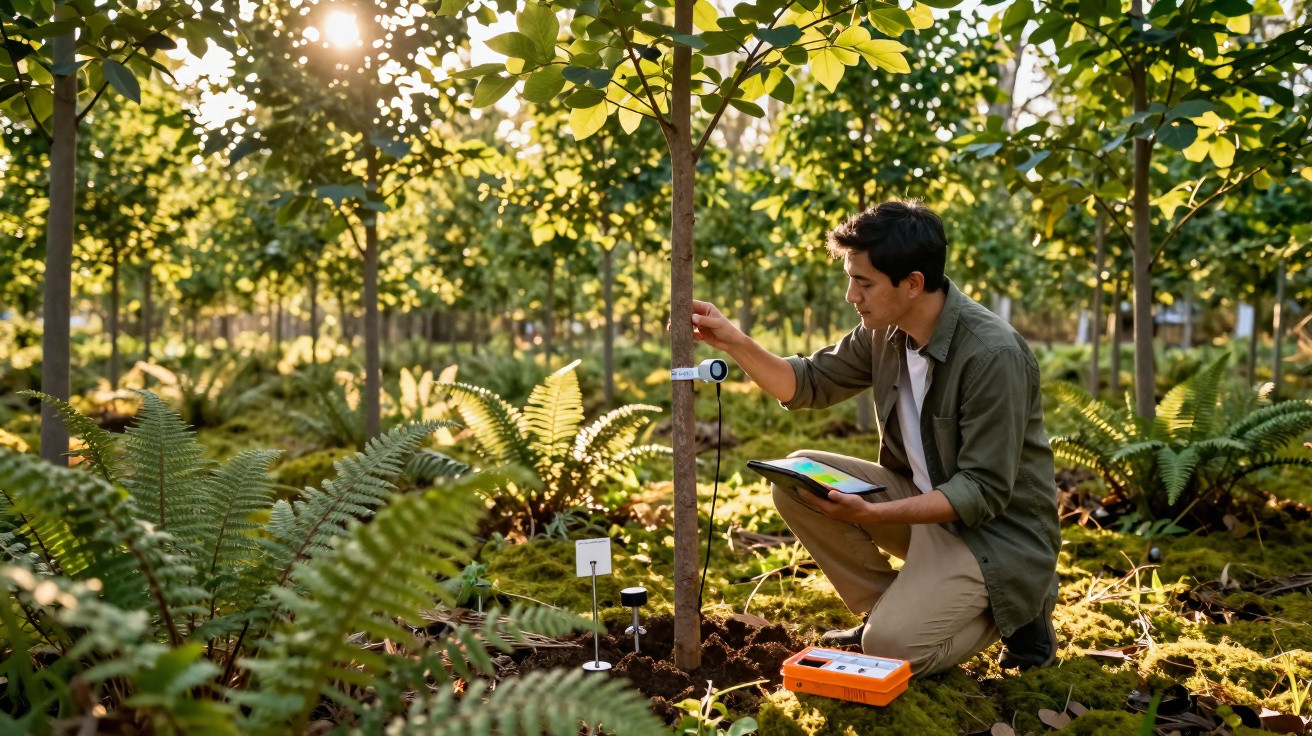
New research indicates that forests, particularly those still growing, are quiet heavyweights in the fight against global warming. Every year, they lock away vast quantities of CO₂ – substantially more than many climate models have assumed to date. Their impact depends on forest age, nutrients in the soil, and how people manage clearance and reforestation.
How forests absorb climate gases – and why age is crucial
Trees remove CO₂ from the atmosphere, use photosynthesis to turn it into biomass, and store the carbon in their roots, trunks and branches. Some of it remains locked in wood and soils for centuries, provided the forest is not burned or cleared.
“The greatest lever lies not only in new tree-planting campaigns, but in forests that are currently in their growth phase.”
The age of a forest stand is therefore critical:
- Young trees grow rapidly and capture large amounts of carbon each year.
- Middle-aged forests enter the period when their growth rate is at its highest.
- Very old forests grow more slowly, but hold immense quantities of carbon as a long-term reserve.
Recent assessments from the United States show that its forests have stored more carbon over the past twenty years than during any other period in the previous century. The main explanation is that many stands are now in this particularly vigorous stage of growth.
Record figures from the United States: forests as an overlooked carbon account
Climate trends such as higher temperatures, shifting rainfall patterns and greater CO₂ concentrations in the air encourage plant growth. However, the age profile of forests has the strongest effect: estimates suggest that forests in their growth phase store around 89 million tonnes of additional carbon every year – in the United States alone.
Human activity also plays a part. Three factors pull in opposing directions:
- Leaving ageing stands standing: Avoiding premature felling allows major carbon stores to keep increasing.
- Planting and reforestation: New trees are added, and can become powerful CO₂ sinks in future.
- Clearance and land-use change: When forest is converted into cropland, pasture or built-up land, much of its stored carbon is released.
Current figures show that the United States loses roughly 31 million tonnes of carbon each year through forest clearance, while reforestation programmes capture about 23 million tonnes. Overall, the balance remains positive – for now. A rise in clearance rates or more years of extreme drought could undo this progress again within a few decades.
The hidden tropical forest puzzle piece: nitrogen
A different issue is central in tropical regions: the nutrient supply of the soil. Many tropical soils have been depleted by decades of intensive use. Above all, they lack one element: nitrogen.
Nitrogen is essential for plant proteins and, therefore, for growth. In young, regenerating tropical forests, this shortage limits how quickly biomass can accumulate. Field experiments show that when soils in these recovering forests receive sufficient nitrogen, the forest grows almost twice as quickly during its first ten years.
“With enough nitrogen, regenerating tropical forests could capture around 820 million tonnes of additional CO₂ per year – over an entire decade.”
That is equivalent to roughly two per cent of current global greenhouse-gas emissions. For the global climate balance, it could provide a significant buffer, buying time to transform industry, transport and agriculture.
When too much nitrogen makes a forest unhealthy
There is, however, another side to the issue. A nitrogen boost can help depleted land, but other forests are already suffering from an excess. In particular, areas with high levels of industrial air pollution receive large nitrogen deposits on their soils and leaves.
In ecosystems that are already saturated, further fertilisation can trigger dangerous side effects. Studies report that soil respiration can then fall sharply. This refers to the activity of soil organisms that break down dead plant matter and release nutrients.
If this cycle collapses, nutrient replenishment slows, the soil becomes structurally poorer, and the stability of the entire forest ecosystem is put at risk. What begins as a short-term boost in growth can therefore turn into long-term damage.
Boreal forests: northern carbon stores on the rise
There is considerable potential farther north as well. Boreal forests – the vast conifer belts across Canada, Alaska, Scandinavia and Siberia – have expanded significantly in area over recent decades.
Between 1985 and 2020, their extent increased by around 12 per cent, an addition of approximately 844,000 square kilometres. At the same time, the tree line shifted northwards by almost 0.3 degrees of latitude. Put simply, the Earth’s cold store is moving towards the Pole.
Young boreal forests in particular are important CO₂ stores. Stands less than 36 years old already contain between 1.1 and 5.9 petagrams of carbon – in other words, billions of tonnes. If these forests are allowed to mature undisturbed, they could store an additional 2.3 to 3.8 petagrams of carbon. This is comparable with several years of emissions from a major industrialised country.
Secondary forests: the underestimated returners
Alongside northern conifer forests, so-called secondary forests are attracting increasing attention. These are forests that return naturally or through planting on former arable land, pasture, or land following timber harvesting.
“Secondary forests can absorb up to eight times more carbon per hectare than newly established plantations when the full life cycle is considered.”
The reason is that the recovery process is already running at full speed on land that is reforesting. Soils often still contain abundant organic material, roots loosen the substrate, and the mix of species is already well suited to the site.
Protecting such stands often delivers more for the climate balance than relying solely on large-scale new planting. Reforestation campaigns that do not also protect existing areas of regeneration therefore partly disappear into the statistical noise.
What policymakers can learn from the new findings
The new evidence suggests that forestry climate strategies need much more precise targeting. Three priorities stand out:
- Protect forests in their growth phase: Do not fell stands prematurely when they are capturing CO₂ at their highest rate.
- Safeguard regenerating land: Do not convert secondary forests back into farmland or plantations.
- Use nutrients more selectively: Apply nitrogen only where soils are clearly under-supplied, and avoid over-fertilisation.
This creates a clear picture: not every line of trees beside a motorway automatically delivers a climate benefit. Far more important are extensive, well-managed forest landscapes in which different age classes exist side by side and natural processes can proceed largely undisturbed.
What the technical terms mean
Several key terms recur throughout the debate. Here is a brief explanation:
| Term | Meaning |
|---|---|
| Carbon sink | A system that absorbs more CO₂ than it releases, such as growing forests |
| Sequestration | The long-term storage of carbon, for example in wood or soils |
| Secondary forest | Forest that regrows after clearance or previous use |
| Boreal forest | Conifer forests in high northern latitudes, often on permafrost soils |
These terms underline that the issue is not simply “more trees”, but where trees grow, how old they are, which species are present, and the kind of soil in which they are rooted.
What this means for German-speaking countries
Forest strategies are also becoming increasingly important to climate policy in Germany, Austria and Switzerland. Dry summers, bark beetles and storm damage are placing severe pressure on spruce monocultures. At the same time, millions of hectares of new mixed woodland are developing, made up of beech, oak, fir, maple and Douglas fir.
Findings from the United States, the tropics and northern regions provide clear practical guidance for these countries:
- Establish resilient mixed forests that can cope better with heat and drought.
- Do not abandon damaged areas too quickly; instead, guide them purposefully through regeneration.
- Account for the carbon value of timber products, favouring long-lasting construction timber over short-lived products.
Forests cannot stop climate change on their own. But if forestry and policymakers use their potential more intelligently, this natural climate-protection system can buy valuable time – precisely when every tonne of avoided CO₂ matters.












Comments
No comments yet. Be the first to comment!
Leave a Comment