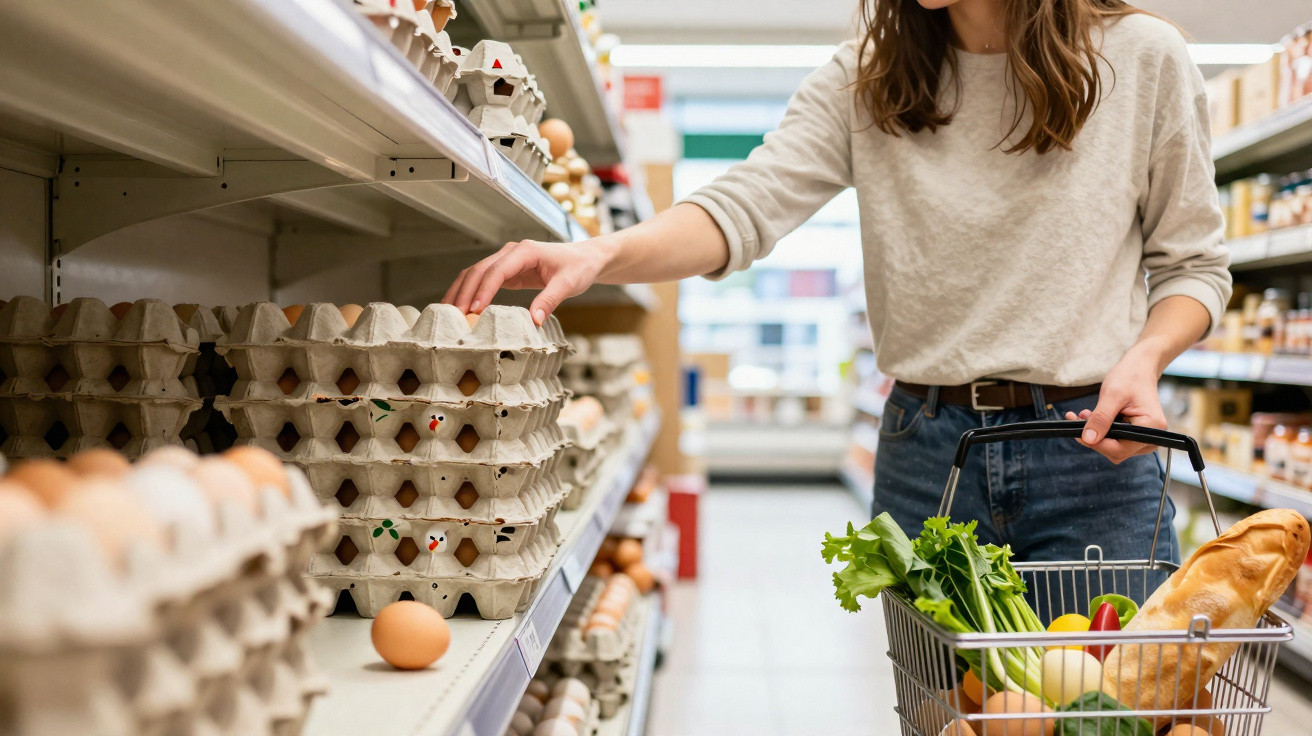
Major retail chains like to promote happy hens and a green image. Yet inspections on the ground reveal a different reality: even where an end to caged hen systems has long been promised, eggs from hens kept in wire cages are still finding their way into shoppers’ baskets. A French survey covering almost 400 stores provides a revealing snapshot – and raises questions that are just as pressing across German-speaking countries.
Promises to end caged eggs – what actually reaches the shelves
As early as 2016, several major French retailers announced that they would completely phase out eggs from caged systems by 2026. This expressly covered not only branded products but also the crucial own-label ranges through which supermarkets sell large volumes and set the price points on the shelves.
The momentum came primarily from the animal welfare debate. Images of laying hens in cramped battery cages sparked public outrage, while animal welfare and consumer groups launched campaigns. Retailers in many countries, including Germany, responded with public commitments and timetables.
“Over just ten years, the share of cage eggs on shop shelves has fallen markedly – but they are still far from having disappeared altogether.”
The French figures illustrate the change: in 2016, slightly more than half of eggs sold by retailers came from caged systems. By 2025, the proportion had fallen to around 14 per cent. That is a historic low, but it is not zero.
Seven in ten stores still sell cage eggs
To assess how seriously retail chains are taking their commitments, the organisation Anima and the data collective Data for Good arranged visits to 386 supermarkets and hypermarkets across France in January 2026. Inspectors checked the egg aisles, with particular attention paid to the production codes printed on the shells.
The findings were sobering: 73 per cent of the stores visited stocked at least one pack of eggs from caged systems, identifiable by the number 3 code on the shell. It was therefore clear that many chains had not consistently fulfilled their pledges to remove these eggs entirely from sale from 1 January 2026.
Major differences between retail chains
More striking still, the results varied dramatically by retailer. At one chain focused on urban locations, only a very small proportion of branches still offered cage eggs at all. At several large rivals, however, cage eggs appeared on shelves in the overwhelming majority of stores – in some cases at well over 80 or even 90 per cent of locations.
The survey also uncovered another notable detail: in 95 per cent of cases, the cage eggs found came from domestic production. Only one major discount chain regularly relied on imported products, chiefly from Poland. According to the team, no eggs from Ukraine were found.
How the industry responds to the findings
When challenged over the figures, retail companies point to “strained markets”. Supplies of free-range, barn and organic eggs are growing, they say, but have not yet kept pace with demand. At the same time, egg consumption remains high: in France, average consumption reached 237 eggs per person in 2025 – a level similar to Germany.
Nevertheless, the transformation on farms is clearly under way. The proportion of hens kept in cages has fallen from more than two thirds of the flock in 2016 to only around one quarter. The industry’s target is for roughly 90 per cent of production to be cage-free by 2030.
One major retail giant publicly criticised the survey methodology. In the company’s view, the campaigners had not recorded stores correctly. The organisation disputes this, stressing that it assessed only fully stocked shelves; empty spaces and exceptional situations were excluded from the statistics.
How shoppers can reliably identify cage eggs
Anyone wishing to choose eggs according to production method does not need an app or specialist expertise. The key is to look for the printed number code on the shell. This system applies across Europe and is also standard in Germany.
“What matters is not the colourful image on the box, but the first digit printed on the egg itself.”
The codes mean the following:
- 0 – Organic: hens have outdoor access, organic feed and are subject to stricter requirements.
- 1 – Free-range: hens can go outdoors, have access to a barn and more space than in an indoor-only system.
- 2 – Barn eggs: hens move freely within the barn but have no outdoor access.
- 3 – Caged systems: hens are kept in cages or enriched colony cages, with limited space.
When choosing quickly from the shelf, many shoppers rely on labels such as “country egg” or idyllic imagery. However, such marketing terms have little legal protection. To be certain, shoppers must take an individual egg from the box and check its first digit.
The blind spot: eggs used in processed foods
The investigation highlighted another issue: around 35 per cent of eggs consumed in France do not reach kitchens as shell eggs at all. Instead, they are used as egg products – liquid or dried egg incorporated into baked goods, pasta, sauces and ready meals.
Different purchasing rules often apply in this sector. Manufacturers tend to focus more heavily on price and less on the visible image presented on supermarket shelves. Consumers generally cannot tell from packaging which production method was used for the eggs inside.
This is where a major tension lies: even if supermarkets eventually remove all shell eggs from caged systems, most cage-based production could still disappear into industrially made food – including biscuits, mayonnaise and frozen snacks.
Legislation, inspections and Brussels’ role
In both France and Germany, public authorities oversee the egg market, check labelling and examine whether retail companies are complying with their commitments. In France, this includes an authority responsible for consumer protection and fraud prevention; in Germany, similar responsibilities lie with food control authorities at state and local level.
At the same time, the European Union is working on tighter animal welfare rules. A citizens’ initiative calling for an end to cages in farming has significantly intensified the debate in Brussels. Future EU legislation could result in cage systems gradually disappearing from the food trade – not only for eggs.
What stricter rules could mean in everyday life
Tougher requirements would force farmers to convert their housing or switch systems entirely. That would require substantial investment and time. Retail chains would need to reorganise supply chains and revise long-term contracts. Prices for consumers could rise, at least temporarily, if supply becomes tighter.
Pressure is also mounting from the other direction. Many customers expect affordable food, especially at times of high living costs. Discount retailers see themselves as responsible for offering cheap eggs, and are therefore more likely to turn to production method 3 when other sources are scarce or considerably more expensive.
Practical tips for your next shop
Anyone wanting to make a personal contribution does not have to buy only organic products. Even a straightforward list of priorities can make a difference:
- For shell eggs, choose code 0 or 1 wherever possible.
- Before buying a box, take out at least one egg and check its code.
- Be particularly alert to special offers with very low prices.
- Ask your local baker or favourite café which eggs they use.
- When baking or cooking, occasionally choose a dish that uses fewer eggs.
One realistic approach is to deliberately select higher-welfare systems for scrambled eggs, fried eggs or breakfast eggs, and to opt for at least barn eggs rather than cage eggs for cakes or pancakes. This helps spread demand somewhat more fairly across the different production methods.
Why cage eggs remain a contentious issue in Germany
Germany faces the same tensions: high egg consumption, price pressure and growing awareness of animal welfare. Major retail chains there have also set out plans to move away from caged systems. The French figures demonstrate how wide the gap between announcements and reality can become when inspections are lacking or demand does not match supply.
For consumers across German-speaking countries, this means not relying solely on promises and colourful labels, but looking more closely themselves. The small number code on an eggshell reveals more about a hen’s life than any advertising image of a green meadow ever could.












Comments
No comments yet. Be the first to comment!
Leave a Comment