Every estimate of iron transport through Arctic and mountain soils has traditionally relied on the same premise: chemical reactions slow once temperatures fall below freezing. The colder the soil, the less mineral weathering is expected to take place.
Scientists in northern Sweden have carried out an experiment that challenges this view.
In some circumstances, ice can extract iron from widespread soil minerals more than four times faster than cold liquid water.
Ice accelerates mineral breakdown
Jean-François Boily, a professor in Umeå University’s Department of Chemistry, has long questioned the idea that frozen settings are chemically inactive.
His research team decided to examine the issue directly. They studied iron minerals, in particular goethite, a rust-coloured material widespread in soils, sediments and dust.
The experiment was performed under two conditions: in liquid water just above freezing and in solid ice at temperatures well below freezing.
The mineral degraded more rapidly in ice than in the cold liquid. The increase closely matched the strength with which each dissolved salt attaches to iron.
Tiny liquid pockets concentrate the reaction
The leading explanation lies in the processes that occur as water freezes. Pure ice cannot accommodate dissolved salts or suspended mineral particles, so it forces them out.
These impurities then accumulate in minute pockets of unfrozen liquid between ice crystals.
Levels within these pockets can become around 500 times greater than in the surrounding water, apparently fuelling the quicker chemical reactions.
Within these densely concentrated pockets, the reaction that removes iron from a mineral grain can proceed much more quickly than it would in a dilute liquid.
Ice does not carry out the chemistry itself; it concentrates the ingredients and keeps them together.
Salt produces a faster reaction
The team examined four dissolved compounds: fluoride, sulphate, chloride and perchlorate. Three of these bind to iron at different strengths, whereas perchlorate has almost no interaction with iron and was used as a control.
In liquid water, the compounds that bind strongly removed iron from the mineral more quickly than weaker binders. This sequence had been observed previously, while ice was assumed to slow all reactions.
However, the researchers found the reverse. Every reactive salt dissolved iron more rapidly in ice than in liquid water.
Fluoride, the strongest binder, released more than four times as much iron in ice as it did in cold liquid water. Perchlorate dissolved no iron in either state.
“The result was remarkably clear. Ice boosted the dissolution rate for every salt that binds to iron, and the stronger the binding, the greater the boost,” said Boily.
Why iron matters
Iron governs the growth of plankton and algae across vast areas of the open ocean, indirectly controlling the amount of carbon absorbed by the water.
A substantial body of research identifies it as one of environmental chemistry’s most important trace elements.
It also attaches to organic carbon in soil, while influencing the colour and acidity of natural water. The quantity that travels from frozen ground into nearby rivers and coastlines can alter the conditions for downstream ecosystems.
Cold regions contain huge stores of iron held in permafrost soils, glacial sediments and ground that freezes seasonally.
The movement of this iron into rivers and oceans is central to understanding the Arctic’s response to warming.
Rivers become orange
The laboratory findings correspond with changes already under way in northern Alaska.
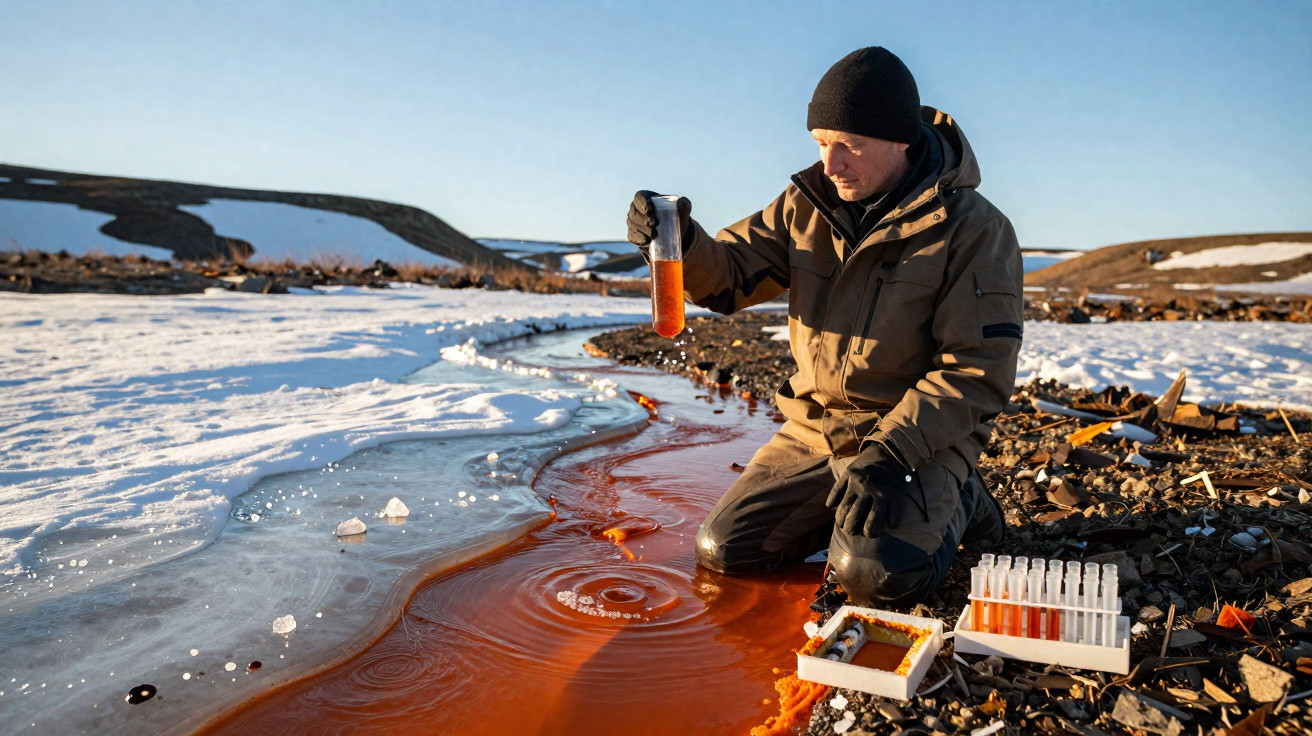
During the past decade, more than 200 streams that were once clear have become cloudy orange, coloured by iron and metals leaching from thawing ground.
Researchers have linked this rust-coloured flow to permafrost exposing previously buried minerals to weathering.
The newly identified ice chemistry provides an additional process: even soil that has not completely thawed may release iron through reactions occurring in its frozen pockets.
According to a recent study, these streams now contain sufficient iron and dissolved metals to damage aquatic insects and put salmon populations at risk.
Understanding which reactions take place within ice gives field researchers a more precise guide to the processes they should monitor.
Models underestimate frozen soil chemistry
Most environmental models regard freezing as the point at which chemistry stops, estimating mineral breakdown from data collected at warmer temperatures and reducing those values.
The latest measurements indicate that this method may have been working in the wrong direction.
About 17 percent of Earth’s land area lies over permafrost, while far larger regions experience annual freeze-thaw cycles.
If ice accelerates iron release instead of suppressing it, nutrient-flow models have been based on incomplete inputs.
This shortfall affects forecasts of carbon storage in northern soils, water quality in Arctic rivers and iron supply to coastal plankton. Active ice chemistry was not included when any of these projections were developed.
A predictive pattern for ice-driven mineral breakdown
Despite the complex chemistry occurring within ice, the new finding is strikingly orderly.
One characteristic - the tightness with which a compound binds to iron - predicted the degree to which ice increased mineral breakdown for every compound tested.
Before this research, no study had demonstrated such a clear relationship between binding strength and ice-driven mineral breakdown. It appears sufficiently simple to incorporate directly into environmental models.
Boily said his team had not expected such consistency among all of the compounds.
Should the pattern prove broadly applicable, it may enable modellers to forecast ice-driven mineral release using a single chemical characteristic - an influence that projections of nutrient movement in cold regions have never considered.
Image credit: USGS










Comments
No comments yet. Be the first to comment!
Leave a Comment