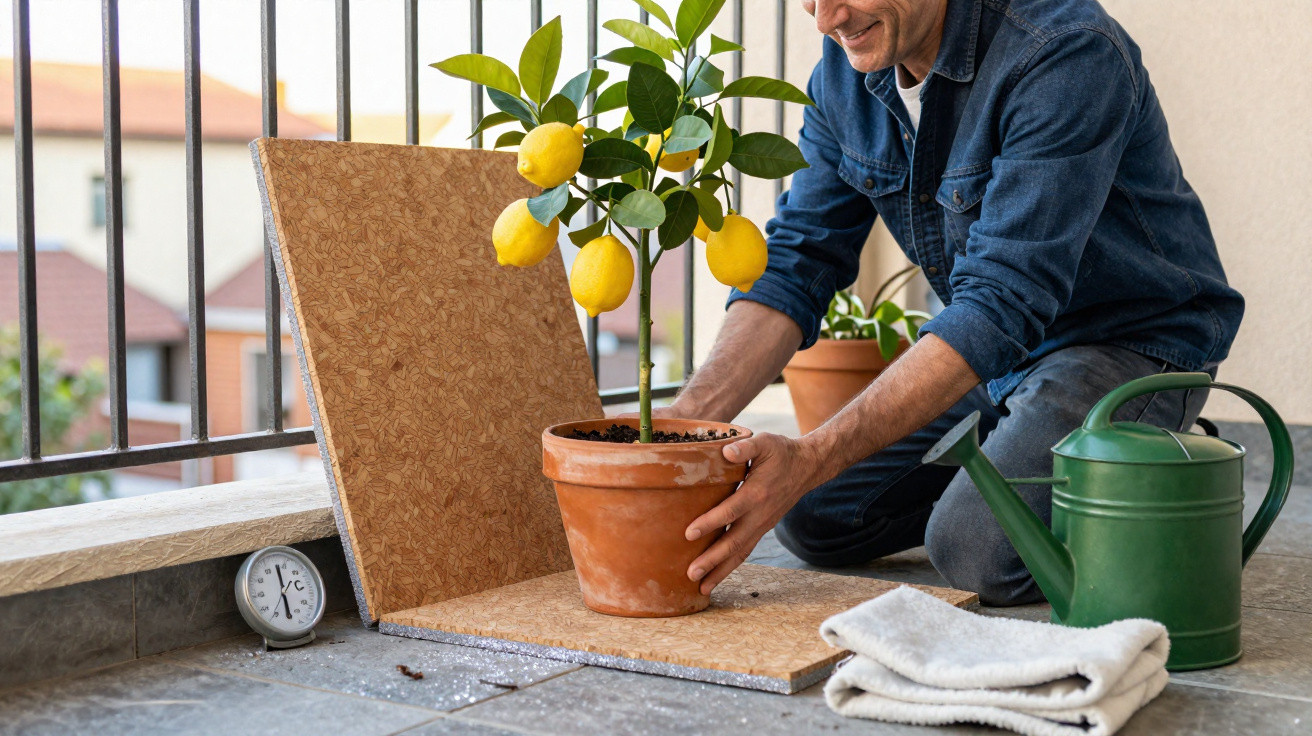
While everyone is already thinking about spring, many potted lemon trees suffer a silent cold shock from below.
As the days lengthen and the first warm rays of sunshine arrive, balconies and patios begin to beckon. Many amateur gardeners put their lemon tree back outside at this point, assuming the worst of winter has passed. Yet one icy March night can severely damage the tree within hours, often without any immediate signs.
Why March is so risky for potted lemon trees
A lemon tree in a pot is far more vulnerable to cold than one growing in garden soil. In the ground, soil acts as a buffer: it stores warmth and releases it gradually. A container lacks this protective mass, leaving the roots much closer to cold outdoor air and the exposed surface.
March is particularly hazardous. Sunshine can warm a balcony or patio during the day, encouraging fresh growth and making the tree appear vigorous and healthy. On clear nights, however, temperatures can still easily drop to minus two or minus three degrees Celsius - and the real danger comes not from the air, but from below.
“The invisible killer is the cold surface: concrete, stone or tiles draw heat out of the pot and freeze the roots.”
Many gardeners focus mainly on the upper part of the tree, using a little horticultural fleece, placing it somewhere sheltered from wind, or watering less. These measures protect against cold from outside, but overlook the crucial issue: cold travels directly from the balcony floor into the base of the pot. That is exactly where the most delicate feeder roots are found.
The overlooked threat: the cold bridge from the ground to the pot
Experts refer to a “thermal bridge” or “cold bridge”: materials such as concrete, ceramic and stone conduct temperature differences very efficiently. When a pot sits directly on tiles or concrete, it creates a direct connection - much like a cold bridge - between the freezing ground and the root ball.
The consequences are:
- The bottom of the pot becomes extremely cold overnight.
- Root tips may freeze through.
- The plant can barely take up any water.
- Foliage starts to wilt, turns dark and may die off.
This is deceptive, as the tree will often still have looked healthy the day before. Damage appears later, once the roots have already died. Owners of south-facing balconies know this situation well: 15 degrees Celsius in the sunshine by day, followed by a light frost at night. Without protection, this temperature swing passes straight into the container.
The simple solution: an insulating board beneath the pot
The good news is that there is no need to wrap the whole tree up or carry it back to its winter quarters. One inconspicuous but highly effective aid is enough: an insulating board placed underneath the pot.
Suitable materials
Lightweight materials that conduct little heat are best, including:
- A polystyrene board, such as one from packaging
- Solid cork or a thick cork mat
- A sturdy, thick wooden base as an emergency option
Two details matter above all:
- Thickness: around 2 to 5 centimetres, so the flow of cold from the ground is noticeably slowed.
- Overhang: the board should extend roughly 1 to 2 centimetres beyond the base of the pot, preventing cold from creeping directly up around the edge.
“This unobtrusive board breaks the direct contact with the cold ground - the cold bridge is cut off, and the roots stay noticeably warmer.”
Once positioned beneath the pot, the board can remain there until around mid-May. It does not get in the way, is barely noticeable visually and can be reused every year.
Keep the drainage hole clear - the right way to do it
Many improvised bases come with one potential problem: they can accidentally block the drainage hole in the bottom of the pot. If water collects inside, the roots can effectively drown - especially during cold nights, when moisture takes a long time to dry out.
A simple DIY solution prevents this:
- Cut three corks in half.
- Arrange the six halves in a ring underneath the pot.
- Set the container on top, with the insulating board beneath it.
This creates a slim layer of air between the pot base and the board. Water can drain away freely, while the air gap also provides an extra buffer against the cold.
How much frost can a lemon tree actually withstand?
A well-protected lemon tree can survive short periods at around minus six to minus seven degrees Celsius. What matters is how evenly the entire plant is protected - its crown, trunk and, above all, the root zone.
Horticultural fleece around the crown provides an average temperature buffer of about three degrees. However, if the container is chilled through from below, the extra protection at the top offers little help. The plant fails from the roots upwards, even when its leaves still look reasonably sound at first glance.
| Protective measure | Effect |
|---|---|
| Insulating board beneath the pot | Breaks the cold bridge and protects roots from ground frost |
| Horticultural fleece over the crown | Keeps the air around leaves and shoots slightly warmer |
| Position beside a south-facing wall | The wall releases warmth stored during the day |
| Raised slightly on feet | Prevents waterlogging and adds an insulating air layer |
Combining protection: keeping the lemon tree safe until mid-May
The insulating board remains the most important measure until the dangerous frost period has genuinely passed. In Central Europe, mid-May is generally used as a rough guide, often in connection with the so-called Ice Saints.
When a cold spell is forecast, it is worth combining several protective layers:
- Keep the pot permanently on an insulating board.
- If frost is predicted, drape horticultural fleece loosely over the crown, ideally supported by canes so the leaves do not touch the fabric directly.
- Move the container close to a sunny house wall, preferably one facing south or south-west.
- Avoid very cold stone or tiled floors; if necessary, raise the pot slightly as well.
For even more root protection, the pot can be given a kind of “second skin”: wrap bubble wrap around the container, then cover it with hessian or a durable fabric to keep the appearance attractive. This allows stored warmth to remain in the pot for much longer.
Watering, position and material: small details with a major effect
Waterlogged compost cools down faster than a substrate that is only lightly moist. For that reason, never water until soaked before a cold night. Slightly moist is ideal, whereas sodden conditions make roots sluggish in the cold and more susceptible to rot.
The pot material also makes a difference. Thin plastic containers react much more quickly to temperature fluctuations than thick-walled terracotta or wooden pots. Choosing with cold protection in mind when buying a container can save a great deal of worry later.
A wind-sheltered location can also reduce frost damage. Cold wind increases water loss through the leaves, while chilled roots can supply hardly any replacement water. This stress causes the well-known “drought frost damage” in many plants: leaves look dried out even though there is enough water in the pot.
Why the effort is worthwhile - and what it teaches us
The insulating-board method sounds almost too basic to be so effective. Anyone who has lost a lemon tree cared for over many years after just one frosty night, however, will never question the few minutes it takes again.
The same principle can also be used for other frost-sensitive container plants: olive trees, bougainvillea, angel’s trumpet and potted fig trees all benefit when their contact with freezing ground is interrupted. On tiled balconies and stone roof terraces in particular, this small detail often determines whether plants live or die.
Taking sensible precautions now in March prevents the disappointment of brown leaves and dead shoots in June. A simple board, a few pieces of cork and a glance at the weather app are all that is needed for the lemon tree to be full of flowers and fruit again in summer.



Comments
No comments yet. Be the first to comment!
Leave a Comment