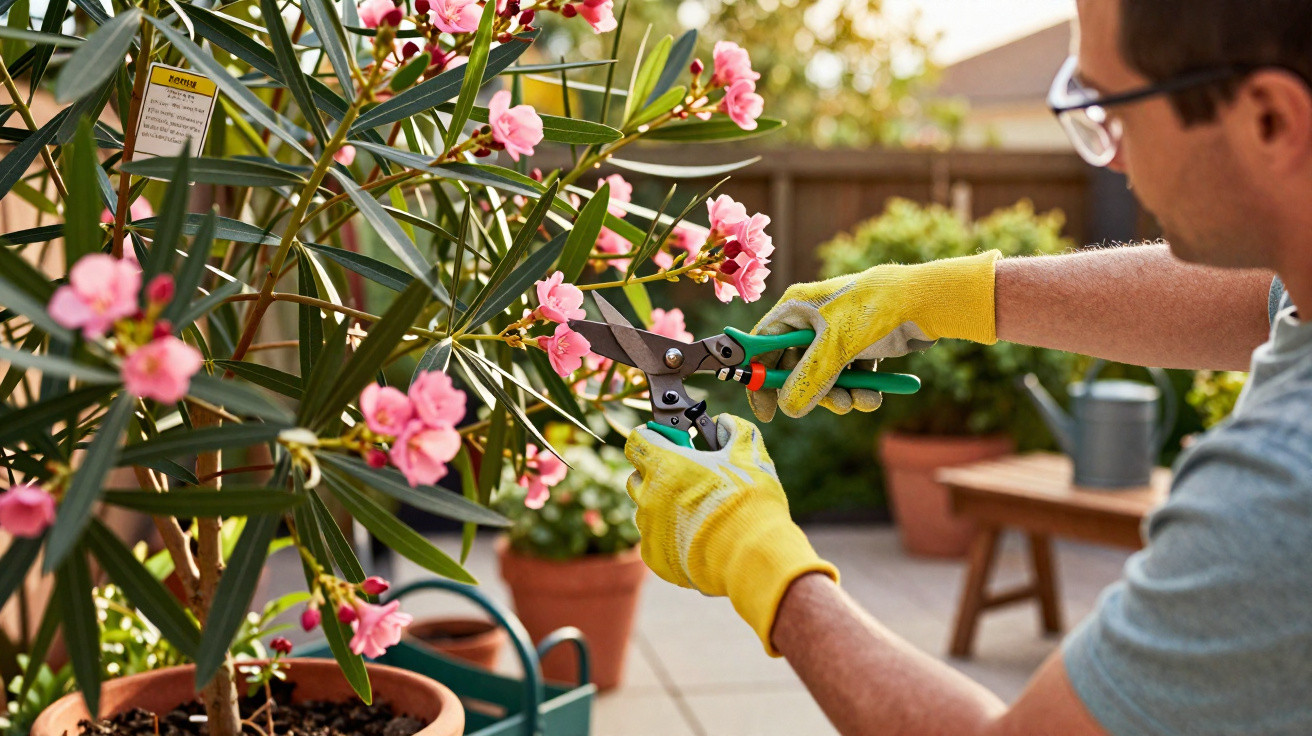
Oleander is often seen as an easy-going sun lover: it enjoys heat and thrives on a patio or balcony. Even so, one poorly timed cut in spring can determine whether the shrub is covered in flowers in summer or remains almost bare. A few straightforward rules make it possible to influence the abundance of blooms deliberately.
Why spring pruning determines summer flowering
Oleander forms its flower buds very early. From late summer onwards, the tips of its shoots already develop the foundations for the following year’s flowers. Pruning indiscriminately or too heavily in spring therefore removes part of this ‘reserve’ of blooms.
The key is moderate, well-timed pruning that encourages fresh shoots without removing the buds already in place.
Oleander flowers mainly on the current season’s shoots, which grow from existing branches. Flower clusters form at their tips. A light trim in late winter or very early spring encourages strong young shoots with good exposure to light. These can then produce abundant flowers from June through to September.
By contrast, a drastic cut just before new growth begins leaves the shrub with too little growth on which buds can develop during summer. The result is plenty of foliage but few, if any, flowers.
The right time for each region
As oleander originates from warmer climates, it has only limited frost tolerance. The best pruning time therefore depends greatly on local conditions.
In mild areas where winter temperatures stay above freezing
In places with comparatively mild winters, such as sheltered coastal areas or warmer, protected districts, pruning is best carried out between mid-March and April. By then, the harshest frosts have usually passed and the plant is close to starting new growth.
- Do not prune until severe overnight frost is no longer forecast.
- Choose an overcast, frost-free day to minimise stress.
- Shorten stems only lightly, leaving enough flower-bearing shoots intact.
Oleander can quickly suffer damage when temperatures fall below around minus five degrees Celsius. Newly cut shoots are even more sensitive to cold. If frost is forecast, leave the secateurs in the shed.
In cooler regions and inland areas
Where winters are harsher, it is better to wait a little longer. Many home gardeners in these areas prune only in late March or April, once the plant has visibly begun to grow again.
Those growing oleander in a container and overwintering it somewhere frost-free have a simpler task. It can be pruned immediately after being moved outside, once temperatures are consistently in double figures. The shrub will then be actively growing, respond quickly and produce new shoots without delay.
It is better to carry out drastic rejuvenation pruning in autumn – in spring, it almost completely suppresses flowering.
How to prune oleander in spring, step by step
Safety first: oleander is highly poisonous
Every part of an oleander plant contains toxic compounds, including its milky sap. Even skin contact may irritate sensitive people. Clear safety measures are therefore essential when pruning:
- Always wear sturdy gardening gloves.
- Wear long sleeves and, ideally, safety glasses as well.
- Clean tools after finishing the job.
- Wash hands thoroughly with soap afterwards.
Keep pets and children away from the immediate work area. Put prunings in household waste or green waste collection, rather than leaving them in an open storage area where animals could chew on them.
Prepare the tools
Clean pruning requires sharp, robust tools. Good bypass secateurs are sufficient for most shoots, while loppers are useful for particularly thick branches.
- Disinfect blades beforehand with alcohol or diluted bleach.
- Sharpen blunt cutting edges to prevent crushed wounds.
- When working on several plants, clean the tools again between plants to avoid spreading disease.
The perfect shape in three stages
For the best results, tackle the pruning in a clear sequence:
Remove dead and diseased wood
Cut back anything black, brown, brittle or clearly frost-damaged to healthy wood. Healthy sections usually reveal a green layer immediately beneath the bark.Thin out the crown
Selectively remove shoots that cross, grow inwards or lie densely over one another. This allows more light into the shrub and enables moisture to dry more quickly – an advantage in preventing fungal diseases.Shorten young shoots
Cut the remaining shoots back by only about one third in most cases. Make the cut at a slight angle, a few millimetres above a pair of outward-facing buds. This directs new growth away from the centre from the outset and prevents an overly dense inner framework.
The rule of thumb is: prune lightly twice rather than too hard once – that way, flowering remains assured.
When a drastic oleander cut-back is worthwhile
Sometimes a gentle approach is no longer enough. Older oleanders that have become bare at the base or have suffered serious frost damage can benefit from a decisive rejuvenation prune.
For this, all main stems can be cut back to around 30 to 50 centimetres above the ground. The shrub will then produce vigorous new growth from dormant buds near the base. It is likely to flower only sparsely in the first year, but this creates the basis for many floriferous years afterwards.
After such a heavy cut-back, give the shrub especially attentive care: use humus-rich, free-draining compost, water regularly without allowing waterlogging, and add a balanced liquid fertiliser to the watering water from spring until late summer.
Common oleander pruning mistakes – and how to avoid them
- Pruning too early when frost remains possible: New shoots can easily be killed by frost, weakening the plant.
- Cutting back too hard every year: The shrub directs its energy into leafy growth, leaving flowering sparse.
- Using blunt tools: Crushed cuts heal poorly and provide entry points for fungi.
- Failing to thin the shrub: A completely overgrown plant is more prone to disease and produces hardly any flowers in its centre.
Care after pruning: getting the most from flowering
Following pruning, oleander needs a strong start to the growing season. Its pot should not be too small, and standing water in the saucer is harmful. In spring, it is worth applying a fresh layer of high-quality container compost over the root ball, adding some slow-release fertiliser if needed.
A position in full sun significantly improves flowering. In too much shade, the shrub produces long, soft shoots with few buds. A site with as much light as possible is especially beneficial after heavier pruning.
Background: why oleander seems both sensitive and resilient
Oleander can appear contradictory. On one hand, it copes remarkably well with drought and heat; on the other, it reacts very badly to cold and waterlogging. This is due to its origins in Mediterranean river valleys, where summers are hot and soils are often damp only briefly.
Its leathery leaves reduce moisture loss. In wet, cold soil, however, the root system quickly suffers, which in turn affects bud formation. This is precisely why the quantity of flowers is so closely linked to the interaction between pruning, watering, temperature and nutrients.
More practical tips for home gardeners
- Carefully remove faded flower clusters without damaging the new buds beneath them.
- Act early in the event of a heavy aphid infestation, for example with a strong jet of water or approved plant-protection products.
- Move container-grown oleanders against a sheltered house wall in winter to prevent frost damage to freshly cut shoots.
Anyone following these guidelines will have little to do in summer. Oleander rewards thoughtful spring pruning with a long-lasting, almost Mediterranean display of flowers – even on a small city balcony.











Comments
No comments yet. Be the first to comment!
Leave a Comment