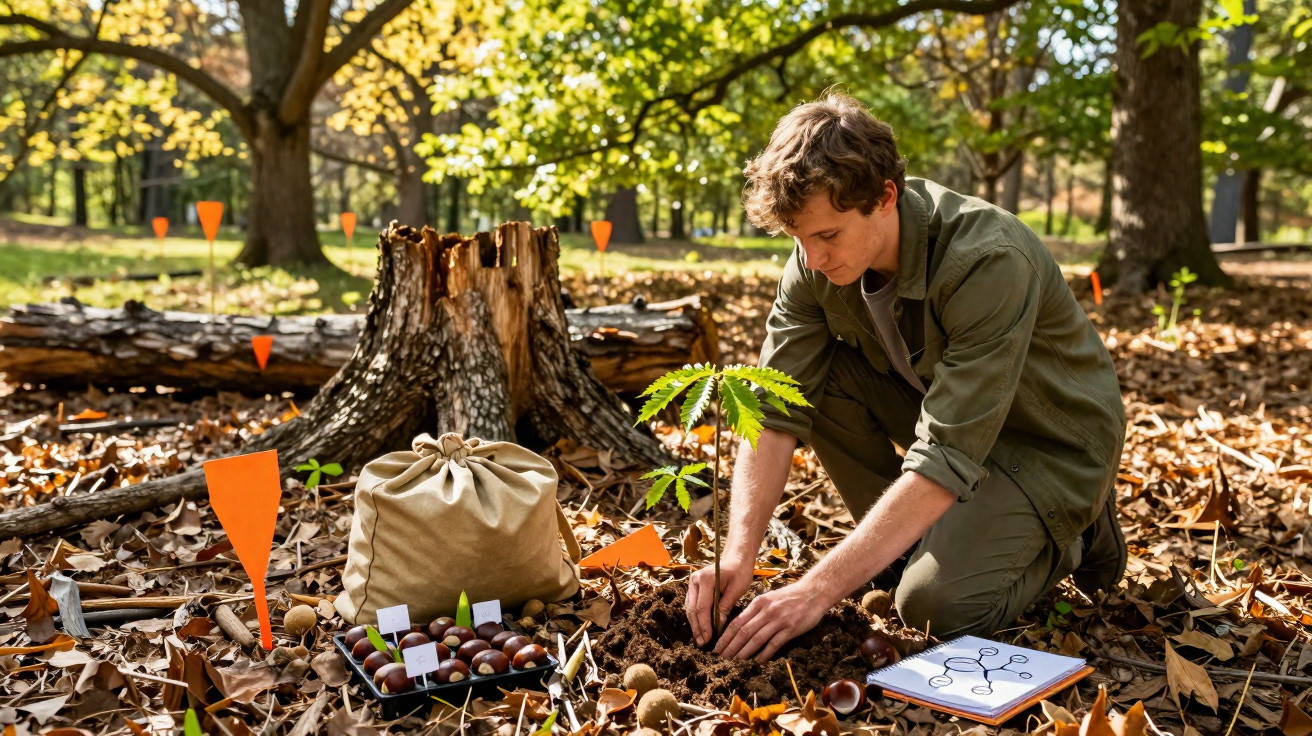
On a misty morning in the Appalachians, the woodland can seem strangely empty. Long-time residents say it was not always this way. American chestnut trees once dominated these hills, growing so huge that families picnicked beneath their limbs while children gathered sweet nuts by the bucketful for festive pies.
Now, there are only ghost forests. Thin chestnut shoots emerge, struggle on for several years, and then fade beneath a disease that arrived more than a century ago and never disappeared. Their bark darkens and splits, their crowns die back, and they become another silent victim of a blight that destroyed billions of trees.
Then, something important changed: scientists finally decoded the chestnut’s genetic blueprint.
A development of that scale begins with one delicate bud.
From forest giant to ghost tree: a century of loss
If you know what to search for in eastern hardwood woods, the traces remain. You may find weathered stumps, some as broad as a car, encircled by fresh shoots making another desperate attempt to grow. Once known as the “redwood of the East,” the American chestnut shaped ecosystems, local economies and family traditions alike.
Its collapse was both swift and devastating. When a fungal blight arrived on imported Asian chestnuts around 1904, it swept through the Appalachians and transformed living giants into decaying, telegraph-pole-like trunks. By the 1950s, the species had effectively vanished as a mature canopy tree. Small mountain communities still feel the consequences of that loss.
That enduring absence is what pulled researchers towards the problem. How can a tree be saved when it is technically still alive but has effectively disappeared from its ecological role? A new Science study, led by an international group of geneticists and forest ecologists, offers one of the most compelling answers yet.
After mapping the American chestnut genome in much greater detail than previous efforts, the team identified genetic signatures that once allowed the tree to outgrow its competitors. They then combined this map with information from Asian chestnut species, which evolved alongside the blight and developed ways to withstand it.
On a laboratory computer, these separate pieces of evidence start to form a route away from extinction.
The central concept appears straightforward: combine the American chestnut’s towering stature and ecological role with the blight resistance of its Asian relatives. In practice, it has proved far more difficult. Traditional crossbreeding over decades produced hybrids with potential, but their results were uneven: some were too weak, while others retained too many “Asian” characteristics.
This genomic toolkit changes the degree of precision available. Scientists can now follow individual DNA regions associated with blight resistance and tree architecture, accelerating selection processes that previously took years. Before seedlings are even large enough to provide shade, researchers can identify which ones deserve further investment.
Let’s be honest: few people have the patience for another hundred-year experiment that may fail.
The American chestnut restoration playbook: breeding, editing and forest testing
The study’s most significant change is not a single miracle fix, but a combined strategy. Rather than framing the issue as a choice between “natural” hybrids and genetically modified trees, the researchers approach the chestnut as a problem with several components. Some lines are created by crossing American and Chinese chestnuts, followed by generations of backcrossing to restore the recognisable American form. Other lines include a carefully inserted gene that increases the tree’s capacity to tolerate the blight’s toxins.
For this work, genomic tools function rather like night-vision goggles. They reveal where particular traits are located within chestnut DNA, which combinations are likely to work well together, and which crosses are likely to fail before leaving the greenhouse. All at once, the slow work of tree breeding seems slightly less like a gamble made while blindfolded.
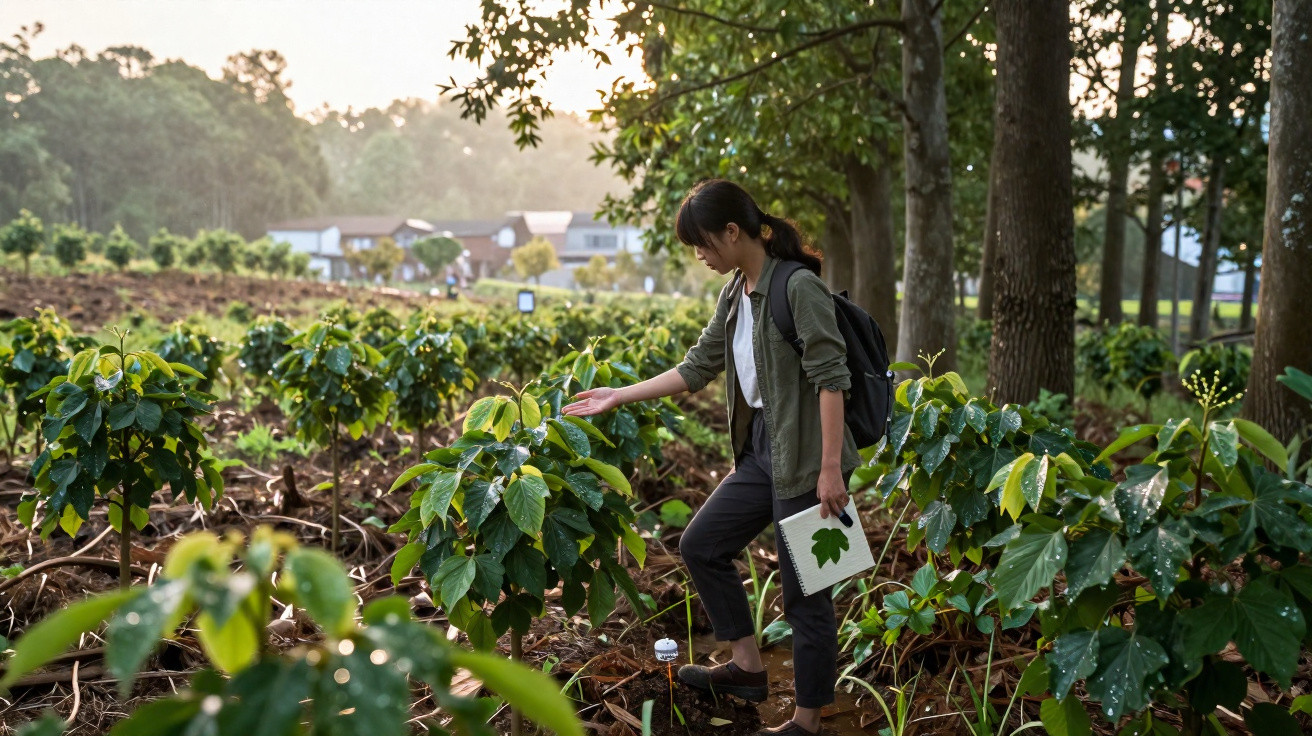
In the field, however, it does not appear especially futuristic. It means muddy boots, plastic tree guards and steep hillsides. Volunteers, students and local landowners are planting young hybrid chestnuts in trial plots across states including New York, Virginia and Pennsylvania. Every sapling is labelled, measured and monitored like a patient in long-term care.
Several of these trees have already reached modest but meaningful milestones: they survive expected surges of blight, gain genuine height and produce burs full of nuts. Some families have even begun roasting trial nuts on winter stoves again, as their grandparents recalled from faded black-and-white photographs. We have all experienced that feeling when something believed lost for ever suddenly seems possible again.
The genomic approach also gives failure a different purpose. A struggling tree is not simply a setback; it is evidence. Researchers can identify the genetic combinations present in weaker specimens and remove those lines early in the process. That conserves years of labour as well as valuable forest land.
There is a firm ecological case for this work, too. Chestnuts once fed bears, deer, turkeys and people, while their enormous trunks stored carbon for generations. Oaks and maples filled part of the gap after chestnuts vanished, but they do not occupy every role the species once held. A robust chestnut adapted to local regions could help secure soils, increase forest diversity under climate pressure and restore a nut crop that once supported rural economies.
One straightforward truth sits at the centre of the project: without a tough, blight-resistant chestnut, rewilding is just a slogan.
What this breakthrough changes for forests - and for us
The new Science paper does more than mark a technical achievement; it subtly changes the model for restoring other lost species. The American chestnut project suggests that nostalgia and progress need not be opposing forces. The first question is what made a species so successful in the first place, and what caused its decline.
The next task is to make that knowledge practical. For chestnuts, this involves genomic markers that help select seedlings able not only to withstand blight but also to grow upright, quickly and tall, closer to their historic and celebrated form. Field trials can then establish whether predictions made in the laboratory survive real rainfall, frost and fungal spores.
Eventually, the same approach could assist ash trees threatened by the emerald ash borer or elms affected by Dutch elm disease.
Even so, forests assisted by genetic technologies make some people uneasy. There are concerns about “Franken-trees”, corporate ownership and the loss of wildness or unpredictability. These are not foolish concerns; they reflect a lengthy record of ecological errors presented as progress.
Chestnut researchers appear highly conscious of that history. Many leading initiatives sit within public universities or non-profit organisations, including The American Chestnut Foundation, and they involve local people in planting and monitoring work. Their focus extends beyond resistance to genetic diversity and avoiding a uniform super-tree that might collapse during the next crisis.
Restoration, they argue, should feel more like a neighborhood rebuilding itself than a uniform plantation descending overnight.
“Bringing back the American chestnut is less about turning the clock back to 1900 and more about giving future forests a fighting chance,” one researcher involved in the Science study told me. “We’re not resurrecting a museum piece. We’re rebuilding a partner species that can adapt with us.”
- Genomic mapping: Knowing where essential traits sit in chestnut DNA gives breeders an accurate means of tracking resistance and form, rather than relying solely on visible characteristics.
- Hybrid breeding: Crossing American and Asian chestnuts, then using the genomic map to guide the seedlings that progress, combines traditional fieldwork with advanced data.
- Field trials and community planting: Evaluating promising trees in real landscapes with local volunteers and landowners reveals which lines can cope with actual weather, soils and wild pathogens.
- Ethical guardrails: Public oversight, open data and regulatory assessment are being incorporated to reduce concerns and prevent restoration becoming a private genetic monopoly.
A future forest that remembers its past
Picture a walk through the Appalachians twenty years from now, when hillsides hold chestnuts that are not merely surviving but once again defining the skyline. Children crack shiny nuts along a path. Bears put on weight from autumn windfalls. Landowners move through mixed woodland and quietly point with pride to “their” young chestnuts.
The Science study cannot promise that future, but it makes it more clearly defined. By identifying the genes that matter, the crosses that succeed and ways to combine resistance with wild character, the research turns broad hope into a plan that can be followed one tree at a time. It is a distinct form of optimism: slower and more technical, yet grounded in real stems and leaves.
Debate will continue. Some people will trust only chestnuts bred without gene insertion. Others will contend that climate change and rapidly spreading diseases require every safe option available, from genomic selection to precisely targeted edits. Forests will offer their own judgement, favouring some lines and rejecting others through storms, drought and unseen battles with microbes.
What stands out is that this time people are not merely watching a species disappear. They are acting carefully, with the humility of those who understand the damage thoughtless introductions can cause. If the American chestnut returns, its comeback will not be pure or perfect.
It may nevertheless be real enough for future generations to assume chestnuts had always belonged here, and to see the absence experienced today as only a short, unusual chapter.
| Key point | Detail | Value for the reader |
|---|---|---|
| Blight nearly erased the American chestnut | More than 4 billion trees were killed after a fungal disease arrived in the early 1900s | Explains why chestnut restoration is such an important ecological and cultural story |
| Genomic tools change the restoration game | Scientists can now identify DNA regions connected to blight resistance and desirable growth traits | Demonstrates how modern science makes ambitious conservation work more achievable |
| Hybrid and gene-assisted trees are being tested | Carefully bred and edited seedlings are already in field trials across multiple states | Indicates that returning chestnuts to eastern forests is no longer merely theoretical but already under way |









Comments
No comments yet. Be the first to comment!
Leave a Comment