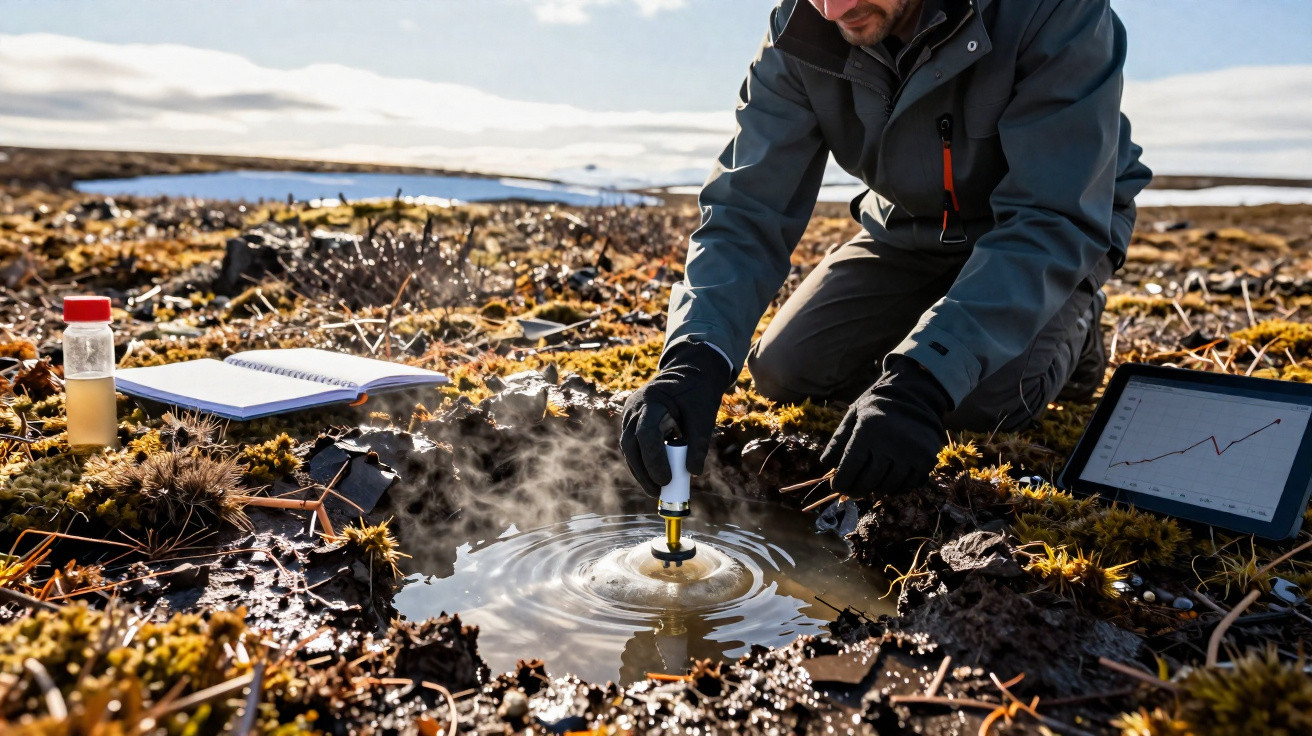
Large parts of the Arctic sit on permafrost: ground that remains permanently frozen. Vast quantities of carbon are locked away there, making it a sleeping giant within the climate system. New research now suggests that, as this ground thaws, soil microbes can access carbon sources previously considered largely secure. As a result, considerably more CO₂ and methane could enter the atmosphere than earlier calculations indicated.
What is hidden in the permanently frozen ground
Permafrost soils extend across Siberia, Alaska, northern Canada and parts of Scandinavia. They contain plant remains, roots and other organic matter that has not fully decomposed over thousands of years because temperatures were simply too low.
More than twice as much carbon is stored in permafrost as is currently present in the entire Earth's atmosphere.
As long as the ground stays frozen, this carbon remains relatively stable and locked in place. When temperatures rise, however, the soil thaws, water enters it, microbes become active and start to ‘digest’ the organic material.
During this process, microorganisms release carbon as carbon dioxide (CO₂) and, where oxygen is scarce, methane (CH₄). Both gases intensify global heating. Over a period of several decades, methane has a warming effect many times greater than that of CO₂.
Microbes consume more than expected
Scientists have understood the basic danger for years: thawing permafrost amplifies global warming through a feedback loop. However, a recent study from the University of Colorado indicates that the scale of this effect may have been underestimated.
Until now, many climate models assumed that microbes could barely attack some of the carbon held in permafrost. The reason was that part of this carbon occurs in particularly complex molecules that are difficult to break down, including compounds known as polyphenols. The prevailing idea was that these ‘stubborn’ substances make life difficult for microbes, inhibit enzymes and thereby slow decomposition.
The new laboratory experiments paint a different picture. Under conditions resembling thawing, partly waterlogged soil - and therefore often without oxygen - researchers identified microbes capable of breaking down precisely these complex polyphenols. They do so far more efficiently than previously assumed.
What was regarded as difficult-to-digest ‘problem food’ for microbes is suddenly proving to be an additional food source - with a direct effect on greenhouse-gas emissions.
The researchers compare this to a buffet. Until now, attention focused mainly on the ‘doughnuts, pizzas and crisps’: readily degradable sugars and fats in the soil. It now appears that microbes will also tackle the ‘spicy dishes’ - the complex polyphenols thought to be unappealing to many organisms.
Why this disrupts climate models
Climate models rely on assumptions: how much carbon is contained in permafrost, how quickly it will thaw, and how microbes respond. These components are used to estimate how much additional CO₂ and methane could be released by 2100.
Earlier studies concluded that emissions from thawing permafrost by the end of this century could be on a scale comparable with the current emissions of major industrialised countries. The new work suggests that this figure may sit towards the lower end of the possible range, because another carbon source must now be considered.
- Easily degradable substances: long recognised as a risk
- Difficult-to-degrade polyphenols: now partly ‘opened up’ to microbes
- Result: soils ‘breathe’ for longer and more intensely, releasing more climate gases over decades
The final scale of the additional effect cannot yet be quantified precisely. Field studies across different regions, measurement campaigns lasting several years, and the incorporation of these new data into global climate models will all be required.
The failed hope of storing carbon in soil
The supposed ‘invulnerability’ of polyphenols gave rise to an ambitious idea in recent years: deliberately adding such substances to thawing soils might, in effect, slow microbes down. Specialists described a kind of enzymatic ‘lock’ that could suppress microorganism activity and retain more carbon in the ground.
This approach is now facing substantial criticism. If microbes can, after all, crack these complex molecules, what was intended as a brake becomes an additional fuel source. Artificially enriching soil with polyphenols could worsen the situation rather than stabilise it.
The idea that permafrost can be deliberately ‘calmed’ using particular substances looks like dangerous wishful thinking in light of the new data.
The study therefore sends a clear message to geoengineering research: technological interventions in natural cycles carry high risks when the system is not understood in every detail. Turning one small cog can rapidly trigger a chain reaction somewhere entirely different.
Why distant soils affect us directly
At first glance, the problem may seem remote: frozen ground in Siberia or Alaska, tundra landscapes where few people live. Yet the gases released there quickly disperse throughout the atmosphere. Their effects cross national borders and extend across generations.
| Gas | Main source in permafrost | Effect on the climate |
|---|---|---|
| CO₂ | Breakdown of organic matter with oxygen | Long-term warming; remains in the atmosphere for a very long time |
| Methane (CH₄) | Breakdown without oxygen in water-rich soils | Considerably more warming than CO₂ during the first few decades |
The higher greenhouse-gas concentrations rise, the more frequent heatwaves, droughts, heavy rainfall and flooding become - including in Central Europe. Permafrost is therefore not a niche issue for polar enthusiasts, but part of the story behind future years of extreme weather in Germany, Austria and Switzerland.
What we need to know about permafrost, polyphenols and microbes
Permafrost: more than simply frozen ground
Permafrost means that the ground remains continuously below zero degrees for at least two consecutive years. In many places, frozen earth extends hundreds of metres deep. It contains not only ice and rocks, but also enormous quantities of dead plant material.
When the ground beneath thaws, buildings subside, roads crack and pipelines deform. Reports of damaged infrastructure are increasing in Siberia and Alaska, providing a directly visible sign that the ‘permanently frozen ground’ is becoming unstable.
Polyphenols: complex molecules with climate relevance
Polyphenols are complex organic compounds found in many plants. In everyday life, they occur in tea, coffee, red wine and berries. They are often considered healthy because they have antioxidant properties.
Large quantities of polyphenols can occur in soil, for example when wood, leaves or roots decompose. There, they bind carbon in stable structures - or so the previous assumption held. The new research shows that specialist microbes can break apart these structures and convert additional carbon into gases.
What the study means for climate policy and everyday life
For international climate policy, the research sends a clear signal: permafrost emissions can scarcely be controlled directly. Once ground starts thawing across large areas, the process largely runs automatically. The most effective lever therefore remains unchanged: rapidly and substantially reduce global emissions from coal, oil and gas before additional feedback loops shrink the available budget further.
For everyday life in Central Europe, this means that every tonne of CO₂ saved counts twice. It not only cuts current emissions, but also reduces pressure on systems such as permafrost, which could otherwise unleash their own avalanche of emissions in the decades ahead.
Research into thawing permafrost will increase over the coming years. Monitoring stations, core samples and long-term observations from the Arctic will provide important data. Every new finding can make climate models a little more realistic, while also demonstrating how sensitively the Earth system reacts when it is pushed out of balance.















Comments
No comments yet. Be the first to comment!
Leave a Comment